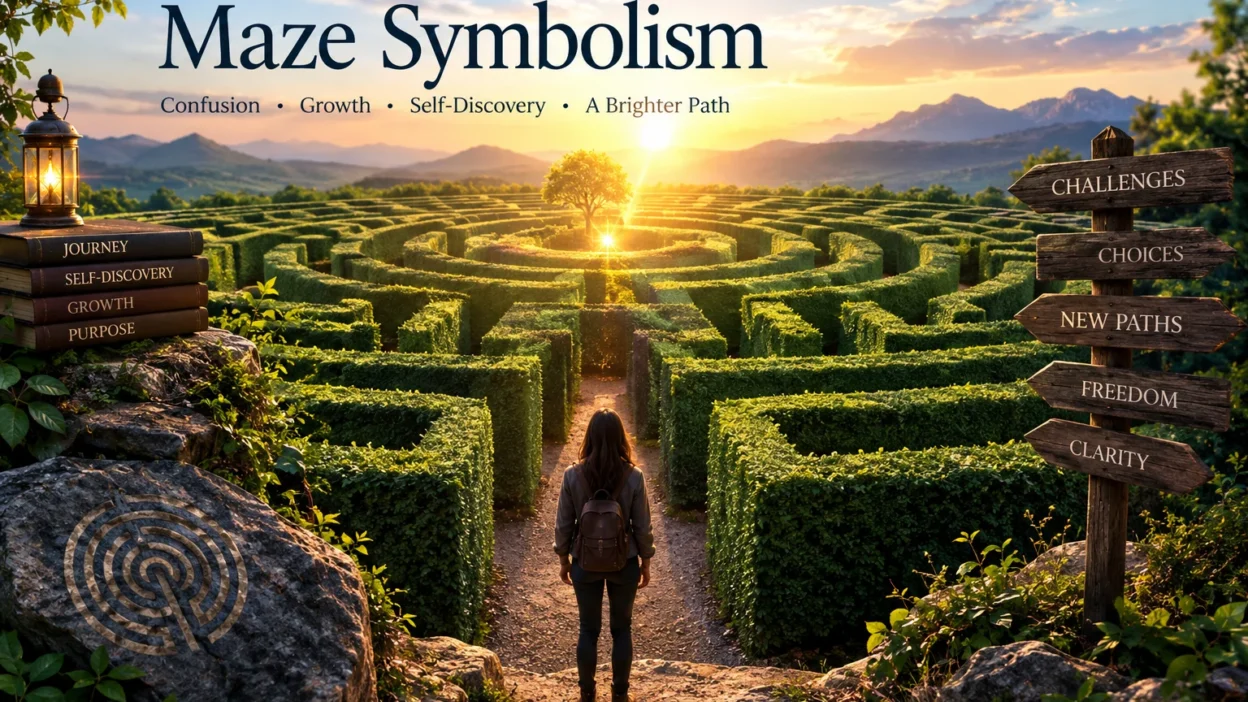
Maze symbolism explores the deeper meanings of confusion, self-discovery, personal growth, and the journey toward finding direction in life. A maze is more than a collection of winding paths and confusing turns. It can represent the challenges we face, the decisions we make, and the patience required to find our way forward.
Throughout history, mazes and labyrinths have appeared in mythology, religious traditions, architecture, literature, and art. People often interpret them as symbols of life’s uncertainty, inner transformation, and the search for truth. If you dream about a maze, encounter one in a story, or use its image in artwork, understanding its symbolism can help you reflect on your emotions, choices, and personal journey.
1. Maze Symbolism as a Journey Through Life
A maze often represents the unpredictable journey of life. Just as a person must navigate winding corridors, we must make decisions, overcome obstacles, and learn from unexpected experiences. The path may not always be clear, but every turn can teach us something valuable.
Best for: Understanding life’s challenges and personal development.
Alternative: Journey symbolism, path symbolism, and road symbolism.
Examples:
- Walking through a maze can represent navigating career choices or important relationships.
- Finding a new passage can symbolize discovering an unexpected opportunity.
2. Maze Symbolism and Confusion
One of the most common interpretations of maze symbolism is confusion. The twisting paths reflect situations in which you feel uncertain, overwhelmed, or unable to determine the best direction.
A maze reminds us that confusion does not necessarily mean failure. Sometimes, uncertainty is a natural part of learning and making thoughtful decisions.
Best for: Reflecting on complicated situations and uncertain choices.
Alternative: Mystery symbolism, fog symbolism, and shadow symbolism.
Examples:
- Getting lost in a maze can represent feeling confused about your future.
- Standing at several intersections can symbolize struggling to choose between different opportunities.
3. Maze Symbolism and Self-Discovery
A maze can symbolize the process of discovering who you truly are. Every turn represents an opportunity to examine your values, beliefs, fears, and desires.
As you explore the maze, you may discover strengths you did not realize you possessed. This interpretation encourages honest self-reflection and personal awareness.
Best for: Personal growth, self-awareness, and identity exploration.
Alternative: Mirror symbolism, soul symbolism, and identity symbolism.
Examples:
- Exploring a maze alone can represent learning to trust your own judgment.
- Finding a hidden room can symbolize discovering an overlooked talent or personal strength.
4. Maze Symbolism and Obstacles
The walls and dead ends of a maze often represent obstacles that make progress difficult. These barriers may reflect financial problems, relationship conflicts, professional challenges, or internal fears.
Instead of suggesting that every obstacle is permanent, maze symbolism encourages patience and creative problem-solving.
Best for: Overcoming difficulties and developing resilience.
Alternative: Mountain symbolism, wall symbolism, and barrier symbolism.
Examples:
- Reaching a dead end can symbolize encountering a failed plan.
- Finding another route can represent adjusting your strategy instead of giving up.
5. Maze Symbolism and Decision-Making
A maze presents choices at nearly every turn. This makes it a powerful symbol of decision-making and the consequences that follow our actions.
Some choices lead to progress, while others require us to reconsider our direction. The important lesson is that thoughtful decisions often matter more than immediate certainty.
Best for: Making difficult choices and evaluating options.
Alternative: Crossroads symbolism, compass symbolism, and fork-in-the-road symbolism.
Examples:
- Choosing between two corridors can represent deciding between two career paths.
- Returning to an earlier intersection can symbolize reconsidering a major life decision.
6. Maze Symbolism and Patience
Finding your way through a maze takes time. Rushing may lead to mistakes, while careful observation can reveal a better route.
Symbolically, a maze teaches patience and reminds us that meaningful progress does not always happen quickly. Sometimes, steady effort is more useful than searching for an immediate solution.
Best for: Developing perseverance and emotional maturity.
Alternative: Clock symbolism, turtle symbolism, and seed symbolism.
Examples:
- Slowly exploring unfamiliar paths can represent learning a new skill.
- Continuing after several wrong turns can symbolize remaining patient during a long-term project.
7. Maze Symbolism and Personal Growth
A maze can represent the challenges that help us grow. Difficult experiences may reveal our limitations, strengthen our abilities, and change the way we understand ourselves.
The maze becomes a metaphor for transformation because the person who reaches the exit may have gained more than a destination. They may also have gained wisdom.
Best for: Personal development and learning from experience.
Alternative: Butterfly symbolism, phoenix symbolism, and transformation symbolism.
Examples:
- Completing a difficult maze can represent overcoming a long-standing fear.
- Learning a maze’s layout can symbolize becoming more confident through experience.
8. Maze Symbolism and Spiritual Awakening
In spiritual interpretations, a maze may represent the journey toward greater awareness and understanding. Its winding paths encourage reflection, quiet observation, and a willingness to explore questions that do not have simple answers.
The meaning depends on the person’s beliefs and cultural background. For some, the maze represents moving beyond distractions to reconnect with their inner values.
Best for: Spiritual reflection and inner exploration.
Alternative: Labyrinth symbolism, meditation symbolism, and light symbolism.
Examples:
- Walking through a peaceful labyrinth can symbolize seeking spiritual clarity.
- Reaching a quiet center can represent feeling connected to your deeper values.
9. Maze Symbolism and Fear of the Unknown
The unfamiliar passages of a maze can represent uncertainty about what lies ahead. Darkness, hidden turns, and unclear destinations may reflect fears about change or unfamiliar experiences.
This symbolism encourages us to recognize fear without allowing it to control every decision.
Best for: Understanding uncertainty and confronting personal fears.
Alternative: Darkness symbolism, cave symbolism, and night symbolism.
Examples:
- Entering an unfamiliar maze can symbolize beginning a new job.
- Hesitating before a dark corridor can represent anxiety about an uncertain future.
10. Maze Symbolism and Finding Your Purpose
A maze can represent the search for purpose, meaning, or a fulfilling direction in life. Although the destination may not be immediately visible, each experience can provide clues about what matters most.
Rather than expecting one perfect answer, this interpretation encourages exploration and reflection.
Best for: Career planning, life goals, and personal purpose.
Alternative: North Star symbolism, compass symbolism, and destiny symbolism.
Examples:
- Exploring several routes can represent trying different professional interests.
- Discovering the exit can symbolize identifying a meaningful long-term goal.
11. Maze Symbolism in Dreams
Dreaming about a maze may reflect feelings of uncertainty, complicated choices, or a desire to find a solution. The emotional atmosphere of the dream can offer clues about its personal significance.
However, dreams do not have one universal meaning. Your experiences, emotions, and circumstances are important when interpreting what a maze might represent.
Best for: Dream interpretation and emotional self-reflection.
Alternative: Dream symbolism, subconscious symbolism, and labyrinth symbolism.
Examples:
- Dreaming of being trapped in a maze may reflect feeling stuck in a difficult situation.
- Dreaming of finding the exit may reflect growing confidence about a problem.
12. Maze Symbolism and Feeling Trapped
A maze with no obvious exit can symbolize feeling restricted by responsibilities, expectations, or circumstances. It may represent a situation in which every available option seems difficult.
This interpretation invites you to identify what is limiting your freedom and consider if a different perspective could reveal new possibilities.
Best for: Reflecting on stressful situations and personal limitations.
Alternative: Cage symbolism, chain symbolism, and prison symbolism.
Examples:
- Being unable to leave a maze can represent feeling trapped in an unhealthy routine.
- Finding a gate in a wall can symbolize recognizing an option you previously overlooked.
13. Maze Symbolism and Hope
Even when a maze seems confusing, the possibility of finding an exit can represent hope. The winding paths suggest that difficulties may be temporary and that solutions can emerge with time and effort.
Hope does not guarantee an easy outcome. Instead, it helps us continue searching for constructive possibilities.
Best for: Staying motivated during challenging periods.
Alternative: Light symbolism, sunrise symbolism, and rainbow symbolism.
Examples:
- Seeing sunlight beyond a maze can symbolize renewed optimism.
- Discovering a previously hidden path can represent finding hope after disappointment.
14. Maze Symbolism and Transformation
A maze can symbolize the changes that occur when we move beyond familiar patterns. Each turn can represent a new experience, while the journey as a whole reflects the gradual process of becoming a different version of yourself.
Transformation may involve uncertainty, but it can also create opportunities for greater understanding.
Best for: Life transitions and personal reinvention.
Alternative: Phoenix symbolism, cocoon symbolism, and rebirth symbolism.
Examples:
- Leaving an old maze behind can represent moving beyond outdated beliefs.
- Entering a new section can symbolize beginning a different stage of life.
15. Maze Symbolism and the Subconscious Mind
Because a maze contains hidden routes and unexpected turns, it can symbolize the complex workings of the subconscious mind. Its structure may represent thoughts, memories, emotions, and beliefs that are not always easy to understand.
Exploring this symbolism can encourage you to notice recurring feelings and reflect on what may be influencing your behavior.
Best for: Journaling, introspection, and emotional awareness.
Alternative: Brain symbolism, shadow symbolism, and dream symbolism.
Examples:
- Exploring hidden corridors can represent examining forgotten memories.
- Finding a room at the center can symbolize recognizing an important personal belief.
16. Maze Symbolism and Control
A maze can represent the limits of our control over life’s circumstances. We can choose how to respond to each turn, but we cannot always predict what lies around the corner.
This meaning encourages a balance between planning carefully and adapting when circumstances change.
Best for: Managing uncertainty and developing flexibility.
Alternative: Wheel symbolism, river symbolism, and fate symbolism.
Examples:
- Planning a route before entering a maze can represent preparing for a project.
- Changing direction after discovering a dead end can symbolize adapting to unexpected circumstances.
17. Maze Symbolism and Intelligence
A maze is often associated with reasoning, observation, and problem-solving. Navigating its passages requires people to remember routes, recognize patterns, and evaluate possible solutions.
Symbolically, it can represent the value of using intelligence and curiosity to approach complicated challenges.
Best for: Learning, strategy, and analytical thinking.
Alternative: Owl symbolism, puzzle symbolism, and key symbolism.
Examples:
- Mapping a maze can represent organizing information before making a decision.
- Recognizing a repeated pattern can symbolize identifying the cause of a recurring problem.
18. Maze Symbolism and Creativity
A maze can represent creative thinking because it encourages exploration beyond the most obvious route. Its many turns suggest that a problem may have several possible solutions.
This symbolism reminds us that creativity often begins when we question familiar assumptions and experiment with new approaches.
Best for: Artistic projects, brainstorming, and innovation.
Alternative: Paintbrush symbolism, imagination symbolism, and butterfly symbolism.
Examples:
- Designing a garden maze can represent expressing creativity through landscaping.
- Finding an unexpected route can symbolize developing an original solution to a work problem.
19. Maze Symbolism and Relationships
In relationships, a maze can represent complicated emotions, misunderstandings, and the effort required to understand another person. People may have different expectations or struggle to communicate their needs clearly.
The maze encourages patience, honest conversation, and the willingness to listen rather than assuming that every problem has an obvious explanation.
Best for: Relationship reflection and communication.
Alternative: Heart symbolism, bridge symbolism, and knot symbolism.
Examples:
- Wandering through a maze together can represent working through a relationship conflict.
- Finding a shared exit can symbolize reaching an understanding through honest communication.
20. Maze Symbolism and Career Challenges
Career paths rarely follow a perfectly straight line. A maze can represent job changes, unexpected setbacks, difficult decisions, and opportunities that appear along the way.
Its symbolism suggests that professional success may involve experimentation and adjustment rather than following a single predetermined route.
Best for: Career development and professional decision-making.
Alternative: Ladder symbolism, road symbolism, and compass symbolism.
Examples:
- Exploring several corridors can represent considering different career options.
- Returning to a familiar intersection can symbolize reassessing your professional priorities.
21. Maze Symbolism and Childhood
Mazes often appear in children’s puzzles, playgrounds, books, and games. In these settings, they can symbolize curiosity, discovery, learning, and the excitement of solving a challenge.
The maze can also represent the process of learning to become more independent while understanding that mistakes are part of growth.
Best for: Childhood themes, education, and playful learning.
Alternative: Puzzle symbolism, toy symbolism, and adventure symbolism.
Examples:
- Completing a paper maze can symbolize developing patience and problem-solving skills.
- Exploring a garden maze can represent childhood curiosity and adventure.
22. Maze Symbolism in Mythology
Mazes and labyrinths appear in several mythological traditions. One of the best-known examples is the labyrinth associated with the Greek story of Theseus and the Minotaur.
In that story, the labyrinth represents danger, complexity, and the challenge of navigating a threatening environment. Theseus’s journey also highlights courage, preparation, and the importance of guidance.
Best for: Mythology, storytelling, and cultural interpretation.
Alternative: Dragon symbolism, hero symbolism, and labyrinth symbolism.
Examples:
- The Greek labyrinth can symbolize confronting a difficult challenge.
- Ariadne’s thread can represent guidance or a practical method for finding one’s way through confusion.
23. Maze Symbolism in Religion and Spiritual Traditions
Labyrinth designs have been used in some religious and spiritual settings as aids for contemplation and reflection. Walking a labyrinth can provide a structured opportunity to slow down, focus attention, and consider personal questions.
A maze and a labyrinth are not always the same: a traditional labyrinth typically has one continuous path leading toward the center and back, while a maze generally offers choices and dead ends. Their symbolic meanings can therefore differ.
Best for: Contemplation and the study of spiritual traditions.
Alternative: Sacred geometry symbolism, prayer symbolism, and meditation symbolism.
Examples:
- Walking a single-path labyrinth can symbolize a reflective spiritual journey.
- Pausing at the center can represent taking time to consider personal beliefs.
24. Maze Symbolism in Literature
Writers often use mazes to represent confusing situations, psychological struggles, and journeys toward understanding. Characters who navigate a maze may face external dangers or discover important truths about themselves.
The maze can also create suspense by delaying the resolution of a story and making the outcome uncertain.
Best for: Literary analysis and creative writing.
Alternative: Journey symbolism, mystery symbolism, and quest symbolism.
Examples:
- A character lost in a maze can represent someone struggling with conflicting loyalties.
- A hidden exit can symbolize discovering the truth after a long investigation.
25. Maze Symbolism in Art and Architecture
In art and architecture, maze patterns can represent complexity, movement, mystery, and the relationship between order and confusion. Their repeated lines and winding paths can also create a sense of rhythm and visual depth.
Artists and designers may use maze imagery to encourage viewers to think about choices, boundaries, and the search for meaning.
Best for: Visual design, architecture, and artistic interpretation.
Alternative: Spiral symbolism, geometric symbolism, and pattern symbolism.
Examples:
- A maze-inspired painting can represent the complexity of human emotions.
- A patterned floor can use labyrinth-like designs to create visual interest and invite contemplation.
26. Maze Symbolism and Hidden Truths
The winding structure of a maze can symbolize the search for information that is difficult to uncover. A hidden passage or central chamber may represent a truth that becomes visible only after careful exploration.
This interpretation encourages curiosity while reminding us to distinguish evidence from assumptions.
Best for: Research, investigation, and self-reflection.
Alternative: Key symbolism, treasure symbolism, and mystery symbolism.
Examples:
- Discovering a concealed corridor can represent uncovering an overlooked fact.
- Reaching a maze’s center can symbolize understanding the main cause of a problem.
27. Maze Symbolism and Boundaries
Maze walls create clear divisions between different paths. Symbolically, these walls can represent personal boundaries, rules, limitations, or the structures that shape our choices.
Boundaries are not always negative. Some protect us, provide direction, and help us focus on what matters.
Best for: Personal boundaries and understanding limitations.
Alternative: Wall symbolism, fence symbolism, and gate symbolism.
Examples:
- A wall blocking a passage can represent a limit that requires a different approach.
- A gate between sections can symbolize setting healthy boundaries in a relationship.
28. Maze Symbolism and Freedom
Finding an exit from a maze can represent freedom from uncertainty, restriction, or a difficult situation. The exit may symbolize the moment when a person recognizes new options and regains a sense of direction.
Freedom in this context can also mean emotional independence and the ability to make decisions according to personal values.
Best for: Independence, fresh starts, and overcoming limitations.
Alternative: Bird symbolism, open-door symbolism, and sky symbolism.
Examples:
- Walking out of a maze can represent leaving a limiting situation.
- Opening an exit gate can symbolize gaining the confidence to make an independent decision.
29. Maze Symbolism and Balance
A maze can reflect the balance between planning and flexibility. Too much hesitation can prevent progress, while impulsive choices may lead to unnecessary detours.
Its symbolism encourages us to combine careful thought with the willingness to move forward when the next step becomes clear.
Best for: Decision-making, work-life balance, and personal planning.
Alternative: Yin-yang symbolism, circle symbolism, and scale symbolism.
Examples:
- Studying a maze before entering can represent preparing for a major responsibility.
- Changing a route when new information appears can symbolize balancing discipline with flexibility.
30. Maze Symbolism and Finding the Way Forward
Ultimately, maze symbolism can represent the determination to continue despite uncertainty. Finding your way does not always mean avoiding mistakes. It can mean learning from them, recognizing patterns, and continuing with greater understanding.
The maze reminds us that progress is sometimes difficult to recognize while we are in the middle of a challenge. Looking back can reveal how much we have learned and how far we have traveled.
Best for: Motivation, resilience, and moving forward after setbacks.
Alternative: Path symbolism, sunrise symbolism, and journey symbolism.
Examples:
- Finding the exit after several wrong turns can represent finally resolving a long-standing problem.
- Leaving a maze with a clearer plan can symbolize gaining wisdom through experience.
FAQs:
1. What does a maze symbolize spiritually?
Spiritually, a maze can symbolize self-discovery, inner reflection, and the search for greater understanding. Its winding paths may represent the challenges people encounter while exploring their beliefs, values, and sense of purpose.
2. What does it mean to dream about being lost in a maze?
Dreaming about being lost in a maze may reflect uncertainty, complicated decisions, or feeling stuck in a situation. However, dreams are personal, so your emotions and current experiences are important when considering a possible interpretation.
3. Is a maze a symbol of confusion or transformation?
A maze can symbolize both. Its confusing paths may represent uncertainty and obstacles, while successfully navigating them can represent learning, personal growth, and transformation.
4. What is the difference between maze symbolism and labyrinth symbolism?
A maze generally contains choices, branching routes, and dead ends, making it a common symbol of confusion and decision-making. A traditional labyrinth usually has one continuous path toward the center and back, making it more closely associated with reflection and a guided journey.
5. What does finding the exit of a maze symbolize?
Finding the exit often symbolizes overcoming obstacles, gaining clarity, solving a problem, or moving into a new stage of life. It can represent the relief and confidence that come from discovering a way forward.
Conclusion
Maze symbolism offers a meaningful way to understand life’s complicated paths, difficult decisions, and opportunities for personal growth. If a maze represents confusion, spiritual exploration, relationships, or the search for purpose, its winding passages remind us that not every journey follows a straight line.
The most important lesson is that getting lost does not always mean you have failed. Sometimes, the wrong turn teaches you something essential, and an unexpected path leads to a better understanding of yourself.
When you encounter a maze in a dream, a work of art, a story, or your everyday life, consider what its paths represent in your own experience. Ask yourself where you feel uncertain, what you are trying to discover, and which small step could help you move forward.

Julian Carter is a writer, poet, and scholar whose work explores culture, identity, history, and human connection. Through thoughtful storytelling and creative insight, he inspires readers to reflect on relationships, memory, and personal transformation.