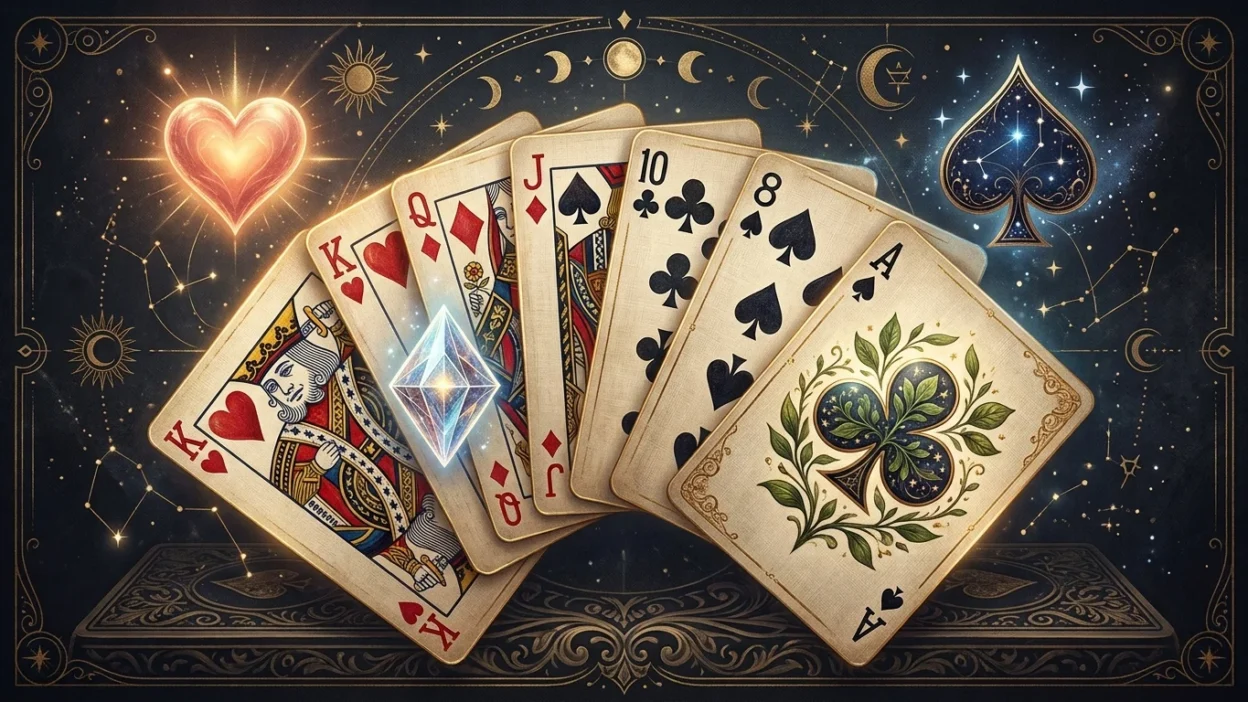
Card symbolism is the study of the meanings, images, suits, numbers, colors, and patterns found on cards. From playing cards to tarot, cards have long been used to represent ideas such as luck, choice, conflict, love, mystery, and personal growth.
Understanding card symbolism can make a card reading, game, artwork, or symbolic interpretation much more meaningful. While meanings vary by tradition and context, learning the common symbols gives you a useful foundation for exploring what a card may represent.
1. What Does Card Symbolism Mean?
Best for: Beginners learning symbolic card meanings.
Alternative: Card interpretation or card meaning.
Card symbolism refers to the ideas represented by card suits, numbers, colors, pictures, and other visual details.
Examples:
A heart may symbolize love or emotion.
A sword may represent conflict, truth, or difficult decisions.
2. The History Behind Card Symbolism
Best for: Understanding where card meanings originated.
Alternative: History of playing cards.
Playing cards developed through different cultures and eventually became associated with games, fortune-telling, and symbolic interpretation.
Examples:
Traditional playing cards use four suits with distinct visual identities.
Tarot cards developed additional symbolic imagery and narrative themes.
3. The Four Card Suits
Best for: Learning the foundation of playing card symbolism.
Alternative: Suit symbolism.
The four suits are commonly interpreted through different themes, although meanings can change between traditions.
Examples:
Hearts are often connected with emotions and relationships.
Clubs may suggest action, effort, or ambition.
4. Heart Symbolism in Cards
Best for: Exploring emotions and relationships.
Alternative: Love symbolism.
Hearts commonly represent affection, compassion, romance, and emotional experiences.
Examples:
The Ace of Hearts can suggest a new emotional beginning.
A Heart card appearing repeatedly may draw attention to relationships or feelings.
5. Diamond Symbolism in Cards
Best for: Money, value, and practical matters.
Alternative: Wealth symbolism.
Diamonds are frequently associated with material resources, prosperity, opportunities, and practical concerns.
Examples:
A Diamond card may represent financial planning.
Several Diamonds may highlight work, possessions, or business matters.
6. Club Symbolism in Cards
Best for: Action and personal effort.
Alternative: Ambition symbolism.
Clubs can symbolize energy, growth, determination, creativity, and taking initiative.
Examples:
A Club card may encourage someone to act rather than wait.
A strong Club pattern may point toward career goals or personal projects.
7. Spade Symbolism in Cards
Best for: Challenges and serious decisions.
Alternative: Conflict symbolism.
Spades are often linked with challenges, transformation, thought, responsibility, and difficult experiences.
Examples:
The Ace of Spades can symbolize a major turning point.
A Spade-heavy reading may suggest the need for careful thinking.
8. Ace Card Symbolism
Best for: New beginnings and potential.
Alternative: Beginning symbolism.
An Ace often represents the start of something, fresh energy, opportunity, or concentrated potential.
Examples:
An Ace of Hearts may suggest emotional renewal.
An Ace of Diamonds may point toward a new financial opportunity.
9. Number Two Symbolism
Best for: Partnerships and choices.
Alternative: Balance symbolism.
The number two commonly represents duality, cooperation, balance, and decisions between two possibilities.
Examples:
Two Hearts may highlight a relationship.
A Two of Spades may represent an important choice.
10. Number Three Symbolism
Best for: Growth and creativity.
Alternative: Expansion symbolism.
Three often represents development, communication, collaboration, and movement from an idea toward reality.
Examples:
Three Hearts can suggest growing emotional connection.
Three Clubs may represent progress on a shared project.
11. Number Four Symbolism
Best for: Stability and structure.
Alternative: Foundation symbolism.
Four is commonly connected with order, security, routine, and strong foundations.
Examples:
Four Diamonds may emphasize financial stability.
Four Clubs can symbolize disciplined effort.
12. Number Five Symbolism
Best for: Change and disruption.
Alternative: Transformation symbolism.
Five often introduces movement, challenge, uncertainty, or the need to adapt.
Examples:
A Five of Hearts may reflect emotional changes.
A Five of Spades may suggest overcoming a difficult period.
13. Number Six Symbolism
Best for: Harmony and recovery.
Alternative: Balance symbolism.
Six is often associated with cooperation, responsibility, support, and restoring balance.
Examples:
Six Hearts can represent emotional harmony.
Six Diamonds may suggest improving financial circumstances.
14. Number Seven Symbolism
Best for: Reflection and inner wisdom.
Alternative: Spiritual symbolism.
Seven frequently carries themes of mystery, reflection, analysis, faith, and deeper understanding.
Examples:
A Seven of Spades may encourage careful reflection.
A Seven of Hearts may suggest examining your true feelings.
15. Number Eight Symbolism
Best for: Movement and personal power.
Alternative: Progress symbolism.
Eight can represent momentum, achievement, organization, and the practical use of personal strength.
Examples:
Eight Clubs may symbolize focused ambition.
Eight Diamonds can suggest productive financial activity.
16. Number Nine Symbolism
Best for: Completion and maturity.
Alternative: Fulfillment symbolism.
Nine is often associated with approaching completion, wisdom gained through experience, and personal fulfillment.
Examples:
Nine Hearts may symbolize emotional satisfaction.
Nine Clubs can represent persistence near the end of a challenge.
17. Number Ten Symbolism
Best for: Completion and transition.
Alternative: Cycle symbolism.
Ten can represent the ending of one cycle and preparation for another.
Examples:
Ten Diamonds may suggest reaching a financial milestone.
Ten Hearts can represent emotional fulfillment or an important relationship stage.
18. Jack Card Symbolism
Best for: Youthful energy and messages.
Alternative: Messenger symbolism.
Jacks are often associated with youthful people, movement, curiosity, communication, or developing skills.
Examples:
A Jack of Hearts may represent emotional news.
A Jack of Clubs may symbolize an energetic new opportunity.
19. Queen Card Symbolism
Best for: Intuition and mature feminine energy.
Alternative: Wisdom symbolism.
Queens can symbolize emotional intelligence, nurturing qualities, intuition, confidence, and leadership.
Examples:
The Queen of Hearts may suggest compassion and emotional wisdom.
The Queen of Spades may represent independence and clear judgment.
20. King Card Symbolism
Best for: Leadership and authority.
Alternative: Power symbolism.
Kings commonly represent maturity, responsibility, leadership, influence, and established authority.
Examples:
A King of Diamonds may symbolize financial leadership.
A King of Clubs may represent ambition and confident action.
21. Red Card Symbolism
Best for: Emotion, energy, and attraction.
Alternative: Passion symbolism.
Red cards are generally connected with warmth, vitality, love, excitement, and emotional intensity.
Examples:
A red Heart card may emphasize romantic feelings.
A red Diamond can combine practical concerns with energetic ambition.
22. Black Card Symbolism
Best for: Mystery, thought, and challenges.
Alternative: Shadow symbolism.
Black cards may carry associations with seriousness, mystery, reflection, uncertainty, or difficult lessons.
Examples:
A black Spade may suggest a challenging decision.
A black Club can represent disciplined effort or obstacles.
23. Joker Symbolism
Best for: Unexpected events and freedom.
Alternative: Trickster symbolism.
The Joker often represents unpredictability, humor, unconventional choices, freedom, or something outside the normal structure.
Examples:
A Joker may symbolize an unexpected opportunity.
It can also suggest breaking away from rigid expectations.
24. Card Symbolism and Luck
Best for: Understanding cultural beliefs about cards.
Alternative: Fortune symbolism.
Cards have a strong connection with ideas of chance and luck because their outcomes can be unpredictable.
Examples:
Drawing an unexpected card can feel like a lucky surprise.
A favorable card may be interpreted as a positive sign in some traditions.
25. Card Symbolism in Tarot
Best for: Spiritual and intuitive interpretation.
Alternative: Tarot symbolism.
Tarot uses rich imagery, archetypes, numbers, suits, and visual storytelling to create layers of symbolic meaning.
Examples:
The Sun is commonly associated with clarity, optimism, and vitality.
The Tower often represents sudden change or disruption.
26. Card Symbolism in Spiritual Practice
Best for: Personal reflection and meditation.
Alternative: Divination symbolism.
Some people use cards as reflective tools to explore emotions, questions, and personal perspectives. Interpretations are subjective rather than scientifically proven predictions.
Examples:
Choosing one card can provide a theme for daily reflection.
Journaling about a card can reveal personal associations.
27. Card Symbolism in Dreams
Best for: Exploring symbolic dreams.
Alternative: Dream card meanings.
Seeing cards in a dream may be interpreted through themes of choice, chance, uncertainty, competition, or hidden information.
Examples:
Dreaming of drawing a card may symbolize waiting for an outcome.
Losing a card may represent fear of missing an opportunity.
28. Card Symbolism in Art and Design
Best for: Creative projects and visual storytelling.
Alternative: Symbolic card imagery.
Card imagery can communicate personality, mystery, fortune, rebellion, romance, or transformation without words.
Examples:
A designer may use a Queen card to suggest confidence.
A Joker motif can create a playful or unpredictable atmosphere.
29. How to Interpret a Card Symbolically
Best for: Beginners creating their own interpretations.
Alternative: Card reading techniques.
Start with the card’s traditional meaning, then consider its suit, number, imagery, color, and surrounding context.
Examples:
A Heart plus a high number may emphasize an important emotional stage.
A Spade surrounded by positive cards may represent a challenge that can be overcome.
30. Why Card Symbolism Still Matters Today
Best for: Modern readers, artists, and symbolism enthusiasts.
Alternative: Modern card meanings.
Card symbolism remains popular because simple images can express complex human ideas such as love, ambition, risk, change, and uncertainty.
Examples:
A card deck can inspire journaling prompts.
Card imagery can help storytellers communicate character traits and themes.
FAQs:
What is the meaning of card symbolism?
Card symbolism refers to the meanings associated with suits, numbers, colors, figures, images, and patterns found on cards.
What do the four suits symbolize?
In common interpretations, Hearts relate to emotions, Diamonds to material matters, Clubs to action, and Spades to challenges or thought. Meanings can vary by tradition.
What does the Joker symbolize?
The Joker often represents unpredictability, freedom, humor, unconventional behavior, or unexpected change.
Is card symbolism the same as tarot symbolism?
Not exactly. Playing cards and tarot share some historical and symbolic connections, but tarot contains additional imagery and interpretive systems.
Can card symbolism predict the future?
Some traditions use cards for divination, but there is no scientific evidence that cards can reliably predict future events. They can still be useful as tools for reflection and storytelling.
Conclusion
Card symbolism gives ordinary cards a deeper layer of meaning. Suits can suggest different areas of life, numbers can represent stages or patterns, and face cards can reflect qualities such as leadership, intuition, or youthful energy.
The most useful approach is to learn traditional meanings while also considering context and personal associations. If you enjoy playing cards, tarot, creative symbolism, or reflective practices, exploring card meanings can turn a simple deck into a fascinating language of ideas.

Julian Carter is a writer, poet, and scholar whose work explores culture, identity, history, and human connection. Through thoughtful storytelling and creative insight, he inspires readers to reflect on relationships, memory, and personal transformation.