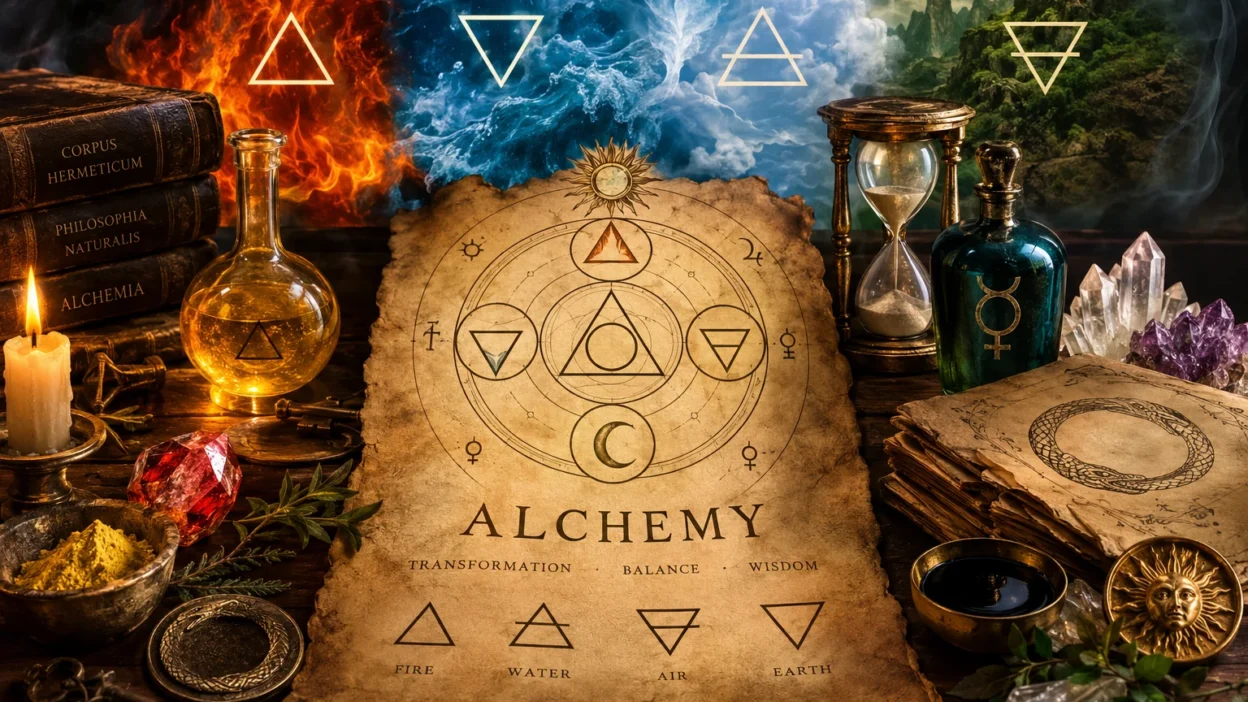
Alchemy symbolism explores the hidden meanings behind ancient symbols associated with transformation, spiritual growth, purification, and the search for wisdom. Historically, alchemists used symbols to represent metals, elements, chemical processes, and philosophical ideas. Many of these symbols also carried spiritual meanings, making alchemy an important part of both early science and mystical traditions.
Today, alchemy symbolism continues to inspire people interested in spirituality, mythology, psychology, personal development, and ancient wisdom. From the mysterious Philosopher’s Stone to the transformative power of fire, each symbol offers a different way to understand change and growth. Learning these meanings can help you appreciate how alchemy connected the physical world with the inner journey of the human spirit.
1. The Philosopher’s Stone Symbolism
The Philosopher’s Stone is one of the most famous symbols in alchemy. Traditionally, it represented the ability to transform base metals into gold and was associated with perfection, enlightenment, and the discovery of hidden truths. Spiritually, it can symbolize reaching your highest potential through patience, wisdom, and personal transformation.
Best for: Understanding spiritual enlightenment and personal achievement.
Alternative: The Philosopher’s Stone can also represent the search for inner peace and self-discovery.
Examples:
A person overcoming difficult experiences may view their growth as discovering their own Philosopher’s Stone.
An artist refining their skills over many years may see the stone as a symbol of achieving mastery.
2. Gold Symbolism in Alchemy
Gold represents perfection, purity, lasting value, and spiritual completion in many alchemical traditions. Because gold resists corrosion and has a beautiful appearance, it became a powerful symbol of something valuable that survives the test of time. Alchemists also associated it with the Sun and the highest stage of transformation.
Best for: Representing success, wisdom, and spiritual maturity.
Alternative: Gold can symbolize confidence, integrity, and lasting achievement.
Examples:
A person who develops strong values through difficult experiences may describe their journey as turning struggles into gold.
A golden sun in artwork can represent enlightenment, vitality, and the fulfillment of potential.
3. Silver Symbolism in Alchemy
Silver is commonly associated with the Moon, intuition, reflection, and emotional awareness. In traditional alchemical symbolism, it represents a different quality from gold, emphasizing receptivity, subtle understanding, and the reflective nature of consciousness.
Best for: Exploring intuition, emotional balance, and inner reflection.
Alternative: Silver can represent feminine symbolism, calmness, and hidden wisdom.
Examples:
A silver moon in a painting may symbolize intuition and the mysteries of the subconscious.
A silver object passed down through generations may represent inherited wisdom and personal memories.
4. Mercury Symbolism in Alchemy
Mercury is one of the central symbols of alchemy. It refers both to the chemical element mercury and to the broader alchemical principle of movement, adaptability, and transformation. Mercury was associated with the ability to move between different states, making it a symbol of change and connection.
Best for: Understanding flexibility, communication, and transformation.
Alternative: Mercury can symbolize the meeting point between opposing qualities.
Examples:
Someone adapting successfully to a new culture may see mercury as a symbol of flexibility.
A character who connects two opposing groups in a story may represent the mediating power of mercury.
5. Sulfur Symbolism in Alchemy
Sulfur represents fire, energy, desire, and active transformation in many alchemical traditions. It was often understood as a principle connected with heat and the force that drives change. Symbolically, sulfur can describe the passionate energy that motivates people to act and reshape their lives.
Best for: Representing motivation, ambition, and creative energy.
Alternative: Sulfur can symbolize intense emotions and the drive to change.
Examples:
An entrepreneur pursuing an ambitious idea may associate sulfur with determination.
A flame in a painting can represent the passionate energy needed to transform an old way of living.
6. Fire Symbolism in Alchemy
Fire is essential to many alchemical processes because heating substances could change their physical properties. Symbolically, fire represents purification, destruction, renewal, and the energy required for transformation. It can also suggest the courage needed to let go of outdated beliefs.
Best for: Personal renewal, courage, and powerful change.
Alternative: Fire can represent passion, creativity, or the destruction of limiting habits.
Examples:
A person leaving an unhealthy routine behind may use fire as a metaphor for releasing the past.
A phoenix rising from flames can symbolize renewal after a major life challenge.
7. Water Symbolism in Alchemy
Water represents dissolution, cleansing, adaptability, and the fluid nature of transformation. In alchemical processes, liquids played important roles in dissolving and separating materials. As a symbol, water often reflects emotional depth, renewal, and the ability to change without losing one’s essential nature.
Best for: Emotional healing, flexibility, and spiritual cleansing.
Alternative: Water can symbolize the subconscious and the flow of life.
Examples:
A river in artwork may represent the continuous process of personal growth.
A person reflecting beside a lake may associate water with emotional clarity and self-understanding.
8. Earth Symbolism in Alchemy
Earth represents stability, physical matter, patience, and groundedness. It is one of the classical elements used in alchemical and philosophical traditions. Earth reminds us that transformation requires a foundation and that meaningful growth often develops slowly.
Best for: Stability, practical wisdom, and building lasting habits.
Alternative: Earth can symbolize the body, material existence, and connection with nature.
Examples:
A seed growing in fertile soil may symbolize the importance of a strong foundation.
Someone patiently building a career may see earth as a reminder to remain grounded while pursuing success.
9. Air Symbolism in Alchemy
Air is associated with thought, communication, movement, and intellectual clarity. As one of the classical elements, it represents the invisible forces that connect things and allow ideas to travel. In symbolic interpretations, air can encourage curiosity and a willingness to consider new perspectives.
Best for: Learning, communication, and mental clarity.
Alternative: Air can represent freedom, imagination, and the movement of ideas.
Examples:
A bird flying through an open sky may symbolize intellectual freedom.
A person learning a new language may connect air with communication and expanding their worldview.
10. The Four Elements in Alchemy
Earth, water, air, and fire form a foundational symbolic system in many historical alchemical and philosophical traditions. Together, they represent different qualities of matter and experience. Their relationships can be interpreted as a model for balance, integration, and the many forces that shape transformation.
Best for: Understanding balance and the relationship between different qualities.
Alternative: The four elements can represent physical, emotional, intellectual, and energetic dimensions of life.
Examples:
A person balancing work, rest, creativity, and practical responsibilities may use the four elements as a personal reflection tool.
An illustration containing mountains, flowing water, wind, and flames can represent the interconnected nature of existence.
11. The Sun Symbolism in Alchemy
The Sun is traditionally associated with gold, vitality, illumination, and active energy. It represents the power that brings things into view and encourages growth. In spiritual interpretations, the Sun can symbolize awareness, confidence, and the emergence of wisdom from uncertainty.
Best for: Representing enlightenment, vitality, and personal confidence.
Alternative: The Sun can symbolize leadership, clarity, and the power of conscious awareness.
Examples:
A sunrise may represent a fresh start after a difficult period.
A golden sun in an alchemical illustration may signify the completion of a transformative process.
12. The Moon Symbolism in Alchemy
The Moon is commonly linked with silver, intuition, reflection, and the changing nature of life. Its phases illustrate cycles of growth, decline, and renewal. In alchemical symbolism, the Moon often complements the Sun, representing qualities that are receptive, reflective, or inward-looking.
Best for: Exploring intuition, emotional awareness, and life’s cycles.
Alternative: The Moon can represent mystery, imagination, and the subconscious.
Examples:
A crescent moon may symbolize a new beginning or the early stages of self-discovery.
A full moon in a painting may represent emotional awareness or the completion of a cycle.
13. The Ouroboros Symbolism
The Ouroboros depicts a serpent or dragon eating its own tail. It is an ancient symbol associated with cycles, renewal, eternity, and the relationship between endings and beginnings. In alchemical traditions, it can represent the unity of a process that continually transforms itself.
Best for: Representing cycles, renewal, and the interconnected nature of existence.
Alternative: The Ouroboros can symbolize self-reflection and the completion of one stage before another begins.
Examples:
A circular snake design may represent the recurring cycles of learning and personal growth.
A story in which the ending mirrors the beginning may use the Ouroboros as a symbol of continuity.
14. The Alchemical Circle Symbolism
The circle is a common shape in alchemical diagrams. It can represent wholeness, unity, continuity, and the cyclical nature of transformation. Because it has no beginning or end, it is also associated with the idea of completeness.
Best for: Symbolizing unity, balance, and completion.
Alternative: A circle can represent a repeating cycle or an integrated sense of self.
Examples:
A circular emblem surrounding the four elements may express their unity.
A ring given to a loved one may represent an enduring bond and commitment.
15. The Triangle Symbolism in Alchemy
Triangles are important in traditional alchemical notation. Upright and inverted triangles were used to represent the four classical elements: fire and air were commonly shown with upright triangles, while water and earth were represented with downward-pointing triangles, with horizontal lines distinguishing the pairs.
Best for: Understanding elemental symbolism and the relationships between forces.
Alternative: Triangles can represent direction, balance, and the relationship between three interconnected ideas.
Examples:
An upright triangle without a horizontal line may symbolize fire in a traditional alchemical diagram.
A downward triangle with a horizontal line may represent earth in classical elemental notation.
16. The Square Symbolism in Alchemy
The square often suggests stability, structure, material reality, and order. When contrasted with the circle, it can symbolize the relationship between the physical world and ideas of spiritual completeness. In alchemical artwork, geometric shapes help communicate abstract concepts.
Best for: Representing structure, stability, and grounded transformation.
Alternative: A square can symbolize the practical foundations needed to achieve a goal.
Examples:
A square surrounding a circle may represent the relationship between material life and spiritual aspirations.
A carefully arranged workspace may serve as a personal symbol of order and discipline.
17. The Alchemical Cross Symbolism
The cross appears in historical alchemical notation, including symbols associated with substances and elemental combinations. Its meaning depends on the specific design and historical context. More broadly, it can suggest the intersection of opposing directions, the meeting of different forces, or the balance between physical and spiritual concerns.
Best for: Exploring balance, intersections, and symbolic connections.
Alternative: A cross can represent the meeting of different paths or dimensions of experience.
Examples:
A cross formed by intersecting lines may symbolize the connection between inner beliefs and outward actions.
An alchemical diagram combining a cross with a circle may invite reflection on the relationship between matter and wholeness.
18. The Green Lion Symbolism
The Green Lion is a striking figure in historical alchemical imagery. It is frequently associated with transformative chemical processes, including imagery involving corrosive substances that act upon metals. Its interpretation varies across texts and illustrations, so it should not be reduced to one universal meaning.
Best for: Exploring powerful transformation and the ability to break down old structures.
Alternative: The Green Lion can symbolize the raw forces that make change possible.
Examples:
A lion consuming a metal or solar emblem in an alchemical illustration may depict an active transformative process.
A person challenging a long-standing assumption may use the Green Lion as a metaphor for questioning what once seemed permanent.
19. The Red King Symbolism
The Red King appears in some alchemical illustrations, often alongside the White Queen. Together, these figures can represent complementary principles and the union of opposites. The Red King is sometimes associated with solar qualities, active energy, or sulfur, although interpretations differ between traditions.
Best for: Understanding active energy and symbolic opposites.
Alternative: The Red King can represent confidence, willpower, and purposeful action.
Examples:
An illustration of a crowned king dressed in red may express authority and active transformative energy.
A story about someone learning to balance determination with patience may echo the Red King’s symbolic role.
20. The White Queen Symbolism
The White Queen is often paired with the Red King in alchemical imagery. She may represent lunar qualities, receptivity, reflection, or the principle associated with silver. Their symbolic union can suggest the integration of complementary forces rather than the victory of one over the other.
Best for: Exploring intuition, reflection, and complementary qualities.
Alternative: The White Queen can symbolize emotional awareness and receptive wisdom.
Examples:
A white-robed queen standing beside a red-clad king may represent the balance of contrasting principles.
A person combining careful listening with decisive action may use the White Queen as a metaphor for thoughtful judgment.
21. The Coniunctio Symbolism
Coniunctio is a Latin term meaning union or joining. In alchemical symbolism, it often refers to the union of opposites, such as Sun and Moon or King and Queen. In psychological interpretations, especially those influenced by Carl Jung, it can represent integrating different parts of the personality.
Best for: Understanding integration, cooperation, and inner balance.
Alternative: Coniunctio can symbolize reconciliation between conflicting ideas or emotions.
Examples:
Two opposing figures joined in an alchemical illustration may symbolize the resolution of a conflict.
A person learning to balance independence with intimacy may view the process as an inner union of opposites.
22. The Rebis Symbolism
The Rebis is a distinctive alchemical figure often depicted with two heads or two complementary aspects within one body. It is associated with the completion of the Great Work and the union of opposites. The figure can represent a more integrated state in which contrasting qualities coexist.
Best for: Representing integration, wholeness, and self-acceptance.
Alternative: The Rebis can symbolize the ability to hold different perspectives without losing a coherent identity.
Examples:
An illustration of a two-headed figure may symbolize the reconciliation of opposing qualities.
Someone learning to combine creativity with logic may use the Rebis as an image of personal integration.
23. Nigredo: The Blackening Stage
Nigredo, or blackening, is a stage in many descriptions of the alchemical process. It is associated with decomposition, breakdown, darkness, and the beginning of transformation. In modern symbolic interpretations, nigredo can represent the uncomfortable period when old beliefs or identities no longer work.
Best for: Understanding endings, uncertainty, and the first stage of personal change.
Alternative: Nigredo can symbolize confronting difficult truths before rebuilding.
Examples:
A person reassessing their priorities after a major disappointment may relate to the blackening stage.
A dark image in an alchemical painting may signify decomposition before renewal.
24. Albedo: The Whitening Stage
Albedo, or whitening, is commonly described as a stage that follows nigredo in alchemical sequences. It is associated with purification, clarification, and the emergence of greater understanding. Symbolically, it can represent the process of making sense of difficult experiences and gaining a clearer perspective.
Best for: Representing clarity, reflection, and purification.
Alternative: Albedo can symbolize emotional recovery and a renewed understanding of oneself.
Examples:
A person who begins to understand a painful experience may view the process as albedo.
White light emerging from a dark background may symbolize a clearer perspective after confusion.
25. Citrinitas: The Yellowing Stage
Citrinitas, or yellowing, appears in some traditional descriptions of the stages of alchemy. It is sometimes associated with the rising Sun, illumination, and the development of wisdom. Not every alchemical text uses the same sequence, but citrinitas offers a useful symbol for growing awareness.
Best for: Representing insight, learning, and emerging wisdom.
Alternative: Citrinitas can symbolize optimism and the gradual development of understanding.
Examples:
A golden-yellow dawn may represent the moment when a difficult situation begins to make sense.
A student connecting previously separate ideas may see citrinitas as a symbol of intellectual growth.
26. Rubedo: The Reddening Stage
Rubedo, or reddening, is often described as a culminating stage in alchemical transformation. It is associated with completion, integration, vitality, and the achievement of a new state. In spiritual interpretations, it can symbolize bringing knowledge and personal growth into everyday life.
Best for: Representing completion, integration, and meaningful achievement.
Alternative: Rubedo can symbolize the confidence that comes from putting hard-earned wisdom into practice.
Examples:
A person who turns lessons from adversity into positive action may relate to rubedo.
A red and gold image at the end of an alchemical sequence may represent the culmination of the Great Work.
27. The Great Work Symbolism
The Great Work, or Magnum Opus, refers to the central transformative goal of alchemy. Depending on the text and tradition, it may involve the production of the Philosopher’s Stone, the perfection of substances, or broader philosophical and spiritual transformation.
Best for: Representing long-term growth, dedication, and the pursuit of wisdom.
Alternative: The Great Work can symbolize a lifelong journey toward a more integrated and purposeful life.
Examples:
An individual developing a meaningful skill over many years may see their effort as a personal Great Work.
An alchemical manuscript illustrating successive stages of transformation may represent the pursuit of perfection.
28. Salt Symbolism in Alchemy
Salt is associated with solidity, preservation, and the material dimension of existence in some alchemical traditions. In the sulfur-mercury-salt framework, salt is often understood as a principle of fixity or bodily form. Symbolically, it can represent the grounded qualities that give ideas a lasting structure.
Best for: Representing stability, preservation, and practical reality.
Alternative: Salt can symbolize boundaries, endurance, and the physical foundation of life.
Examples:
A preserved object may symbolize the ability to protect something valuable through changing circumstances.
A person who consistently follows through on their commitments may embody the stabilizing qualities associated with salt.
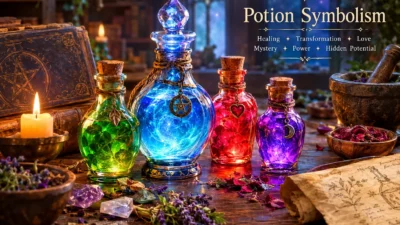
29. The Alchemical Vessel Symbolism
The alchemical vessel was an important practical object used to contain substances during processes such as heating, distillation, and transformation. Symbolically, the vessel can represent the protected environment in which change takes place. It may also suggest the importance of patience and containment during periods of growth.
Best for: Understanding the conditions needed for transformation.
Alternative: A vessel can symbolize a supportive relationship, a learning environment, or a safe space for reflection.
Examples:
A journal used for daily self-reflection may serve as a personal vessel for exploring emotions and ideas.
A supportive classroom may represent a vessel in which students develop new skills and confidence.
30. The Phoenix Symbolism in Alchemy
The phoenix is a mythical bird associated with death, rebirth, and renewal. Although it is not an exclusively alchemical symbol, it appears in broader traditions of transformation and has become a powerful modern image of the alchemical journey. Its story suggests that endings can create the conditions for new beginnings.
Best for: Representing resilience, renewal, and the ability to begin again.
Alternative: The phoenix can symbolize recovery, hope, and transformation after hardship.
Examples:
A person rebuilding their life after a major setback may see the phoenix as a reminder of resilience.
A phoenix rising from flames in artwork may represent the emergence of a stronger identity after change.
FAQs:
1. What does alchemy symbolism mean?
Alchemy symbolism refers to the images, signs, and allegories used in alchemical traditions to represent substances, laboratory processes, philosophical ideas, and spiritual transformation. Common examples include gold, mercury, the Philosopher’s Stone, and the Ouroboros.
2. What is the most important symbol in alchemy?
The Philosopher’s Stone is among the most recognized alchemical symbols. It represents the legendary goal of transforming base metals into gold and is also interpreted as a symbol of perfection, wisdom, and spiritual development.
3. What do the four elements mean in alchemy?
Earth, water, air, and fire represent different qualities of the natural world in classical philosophical traditions. Earth suggests stability, water represents fluidity, air is associated with movement and thought, and fire represents heat and transformation.
4. What are the four stages of alchemy?
A commonly discussed sequence includes nigredo (blackening), albedo (whitening), citrinitas (yellowing), and rubedo (reddening). These stages appear in some alchemical traditions and are often interpreted as a progression from decomposition and purification toward illumination and completion. Historical systems vary, and not every text includes all four stages.
5. Is alchemy symbolism spiritual or scientific?
Alchemy historically combined practical experimentation with philosophical, religious, and cosmological ideas. Its practitioners studied substances and developed techniques that contributed to the history of chemistry, while many also explored symbolic interpretations of transformation. Modern spiritual readings are interpretations rather than universal explanations of every historical symbol.
Conclusionc
Alchemy symbolism offers a fascinating way to explore transformation, wisdom, balance, and the relationship between the material and spiritual worlds. From the Philosopher’s Stone and the Ouroboros to the stages of nigredo, albedo, citrinitas, and rubedo, each symbol carries meanings shaped by historical traditions and later interpretations.
The most useful approach is to consider both the historical context and the personal meaning a symbol holds for you. Gold may remind you of wisdom, water may suggest emotional renewal, and the phoenix may inspire you to begin again. These interpretations can make alchemy symbolism a valuable tool for reflection, creativity, and understanding the many forms of change.
Which alchemy symbol do you find most fascinating? Share your thoughts and explore how its meaning connects with your own journey of growth and discovery.