
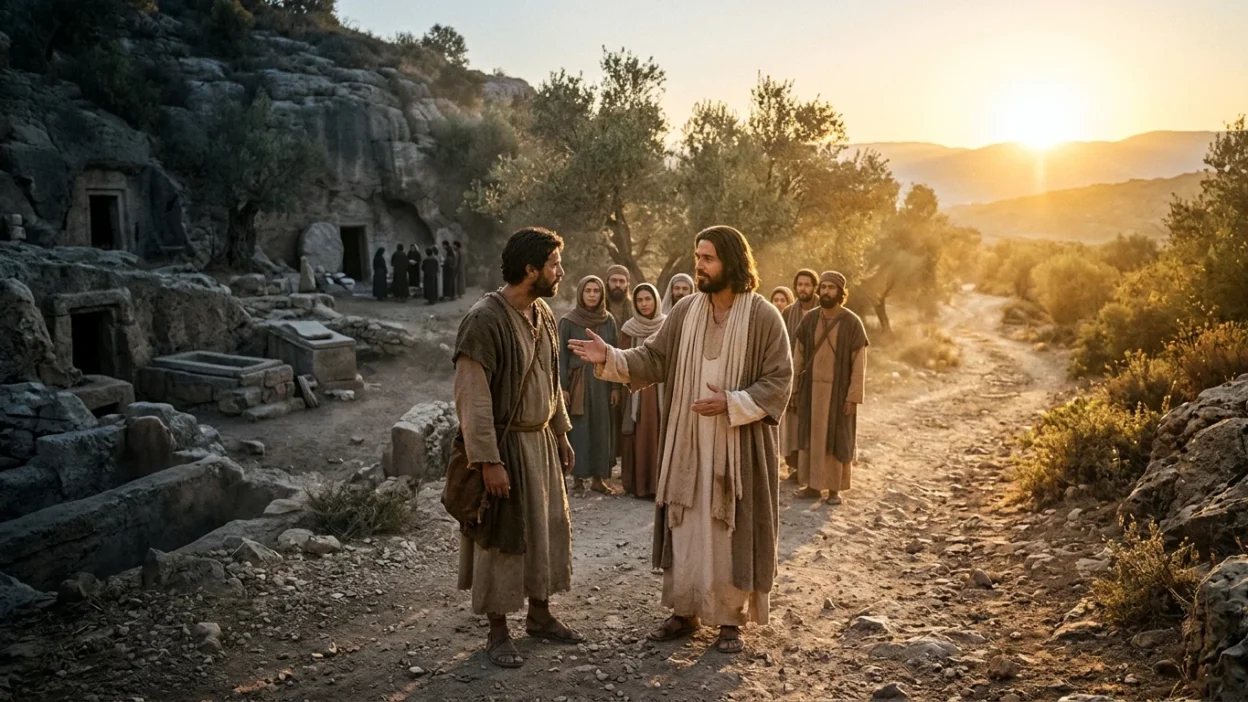
The phrase “let the dead bury the dead” means that people should leave behind old responsibilities, situations, or attachments and focus on following a new purpose in life. It is a well-known biblical expression from the teachings of Jesus in the Gospel of Matthew and the Gospel of Luke. Although it sounds harsh or confusing at first, its message is mainly about priorities, commitment, and moving forward.
When someone asks about the “let the dead bury the dead” meaning, they are usually trying to understand why Jesus used such unusual words. The expression is not simply about death or funeral arrangements. Instead, it uses symbolic language to highlight the difference between spiritual priorities and worldly obligations. Understanding its biblical background, figurative meaning, and modern usage makes it easier to interpret this powerful expression in everyday conversations.
Quick Answer: What Does “Let the Dead Bury the Dead” Mean?
“Let the dead bury the dead” is a biblical phrase meaning that people should prioritize spiritual responsibilities and their life’s purpose over worldly concerns. Jesus used it to emphasize commitment and the importance of following Him without allowing other obligations to become obstacles.
Where Does the Phrase “Let the Dead Bury the Dead” Come From?
The expression comes from the Bible, specifically the teachings of Jesus Christ.
It appears in two New Testament passages:
- Matthew 8:21–22: A disciple asks Jesus for permission to bury his father before following Him. Jesus responds, “Follow me; and let the dead bury their dead.”
- Luke 9:59–60: A similar conversation takes place when Jesus calls someone to follow Him, and the person asks to bury his father first.
These passages present the phrase as part of a discussion about commitment and priorities.
Jesus was teaching that following His calling required a willingness to put spiritual responsibilities first, even when other obligations seemed important.
What Does “Let the Dead Bury the Dead” Mean in the Bible?
In its biblical context, the phrase carries a spiritual message about the difference between physical life and spiritual life.
The first use of the word “dead” is commonly understood figuratively. It refers to people who are spiritually unresponsive or disconnected from God’s calling.
The second use refers to people who are physically dead and need burial.
In other words, Jesus was using the same word in two different senses to communicate a deeper lesson.
The message is that people who are spiritually disconnected can continue handling ordinary worldly responsibilities, while those called to follow Jesus should prioritize that spiritual mission.
Why Did Jesus Say “Let the Dead Bury the Dead”?
Jesus said this to emphasize the urgency of following Him.
A man wanted to take care of a family responsibility before becoming His follower. Jesus responded with a challenging statement to show that spiritual commitment should not continually be delayed.
The passage is not necessarily a general instruction to abandon family members or ignore every personal responsibility.
Instead, it highlights the importance of recognizing when something is preventing a person from fulfilling a greater calling.
Does the Phrase Mean We Should Ignore Our Families?
No. The phrase should not be interpreted as permission to neglect or disrespect family members.
The Bible contains other teachings that emphasize loving, respecting, and caring for family.
Jesus was making a specific point about spiritual priorities and the urgency of discipleship.
The central lesson is that people should not allow ordinary responsibilities or personal attachments to become permanent excuses for avoiding their spiritual commitments.
Why Do People Confuse the Meaning of This Phrase?
People often misunderstand this expression because it uses the word “dead” twice in one sentence.
In ordinary English, death refers to the end of physical life. Therefore, hearing that the dead should bury other dead people can sound strange or even insensitive.
However, biblical language frequently uses physical experiences to communicate spiritual ideas.
Another reason for confusion is that people sometimes read the phrase without considering its historical and religious context.
The expression is also frequently shared on social media, where short quotations may appear without an explanation of the original conversation.
Understanding the two meanings of “dead” makes the expression much clearer.
Understanding the Two Uses of the Word “Dead”
The word “dead” has different meanings in the biblical expression.
1. The First “Dead”: Spiritually Dead
The first use refers to people who are spiritually unresponsive or disconnected from God’s purpose.
It describes a condition of spiritual separation rather than physical death.
For example:
- People who ignore spiritual responsibilities.
- Individuals who do not recognize God’s calling.
- Those who prioritize worldly concerns over spiritual growth.
This interpretation helps explain why Jesus contrasts these people with someone who is being called to follow Him.
2. The Second “Dead”: Physically Dead
The second use refers to people who have died physically.
In the original context, it relates to the burial of a deceased family member.
It represents an ordinary human responsibility that people would naturally consider important.
The contrast between spiritual death and physical death creates the deeper meaning of the expression.
Let the Dead Bury the Dead: Meaning and Explanation
| Element | Meaning |
|---|---|
| Let | Allow or permit |
| First dead | Spiritually unresponsive people |
| Bury | Perform burial responsibilities |
| Second dead | Physically deceased people |
| Overall message | Prioritize spiritual commitment over worldly distractions |
The phrase uses repetition to create a meaningful contrast.
Its message is not that physical burial is unimportant. Rather, it emphasizes that a spiritual calling may require immediate commitment.
What Does “Let the Dead Bury the Dead” Mean in Everyday Life?
Outside its biblical context, people sometimes use this expression figuratively to discuss priorities, personal growth, and moving forward.
For example, someone might use the idea when explaining why they no longer want to remain attached to an unhealthy situation.
The phrase can communicate several related ideas.
1. Leave the Past Behind
It can represent the decision to stop allowing past experiences to control the present.
For example, someone recovering from a difficult relationship may decide to stop revisiting old arguments.
2. Focus on Your Purpose
The expression can remind people to concentrate on meaningful goals instead of allowing distractions to consume their time.
3. Stop Delaying Important Decisions
Sometimes people continually postpone important changes because of smaller responsibilities.
The phrase can serve as a reminder to recognize what deserves immediate attention.
4. Move Forward Instead of Staying Stuck
It can also symbolize letting go of situations that no longer contribute to personal growth.
However, this is a modern figurative interpretation, not the complete original biblical meaning.
What Is the Grammatical Meaning of “Let the Dead Bury the Dead”?
Understanding the grammar makes the phrase easier to recognize and use.
The expression follows a simple English sentence structure.
- Let: Verb used to give permission or express a command.
- The: Definite article.
- Dead: Adjective used as a noun to describe deceased or spiritually dead people.
- Bury: Base-form verb meaning to place a dead person in a grave.
- The dead: Noun phrase referring to deceased people.
The sentence uses the verb “let” followed by an object and the base form of another verb.
Its grammatical structure is:
Let + object + base verb + object.
For example:
- Let him speak.
- Let them decide.
- Let the children play.
- Let the dead bury the dead.
The phrase is grammatically correct and uses repetition intentionally.
Is “Let the Dead Bury the Dead” a Metaphor?
Yes, it contains figurative language, particularly a contrast between physical and spiritual meanings of the word “dead.”
It is also an example of wordplay because the same word is used in two different senses within one sentence.
This technique makes the statement memorable and encourages readers to think beyond its literal meaning.
However, its biblical interpretation should not be reduced to a simple motivational metaphor. Its original meaning is closely connected to Jesus’ teaching about discipleship.
5 Examples of “Let the Dead Bury the Dead” in Context
Here are five examples showing how the expression can be discussed in religious and figurative contexts.
1. Biblical explanation: The pastor explained that Jesus used the words “let the dead bury the dead” to emphasize the importance of spiritual commitment.
2. Religious discussion: During Bible study, we discussed why Jesus asked His followers to prioritize their spiritual calling.
3. Personal growth: She connected the phrase to her decision to stop allowing past disappointments to control her future.
4. Life priorities: His interpretation of the expression reminded everyone to focus on what truly matters.
5. Spiritual commitment: The teacher explained that following Jesus sometimes requires difficult choices and a willingness to put faith first.
10 Additional Practical Examples of the Phrase’s Figurative Message
The following examples demonstrate modern situations connected to the broader ideas of priorities, commitment, and moving forward. They are illustrative interpretations, not direct biblical quotations.
1. After years of regret, she decided to focus on building a better future instead of constantly revisiting the past.
2. He stopped allowing old disagreements to interfere with his personal growth.
3. The expression reminded me that meaningful goals sometimes require difficult decisions.
4. Instead of delaying his spiritual journey, he decided to take his faith seriously.
5. She realized that holding on to unhealthy relationships was preventing her from moving forward.
6. The pastor encouraged the congregation to prioritize their relationship with God.
7. He stopped wasting time on distractions and concentrated on his responsibilities.
8. The phrase encouraged her to let go of things she could no longer change.
9. They discussed how spiritual commitment can sometimes require sacrifices.
10. His decision to move forward showed that he was no longer controlled by his past.
Common Misunderstandings About “Let the Dead Bury the Dead”
Although the phrase is relatively short, several misunderstandings can change its intended meaning.
Mistake 1: Thinking It Literally Means Dead People Should Bury Other Dead People
Incorrect interpretation: Jesus was giving instructions about how dead people should perform burial ceremonies.
Correct interpretation: The expression contrasts spiritual death with physical death.
Mistake 2: Assuming Jesus Was Teaching People to Abandon Their Families
Incorrect interpretation: People should never care for their parents or family members.
Correct interpretation: Jesus was emphasizing the urgency of following Him and prioritizing spiritual commitments.
Mistake 3: Treating It Only as a Motivational Quote
Incorrect interpretation: The phrase simply means forgetting the past and moving forward.
Correct interpretation: That can be a modern figurative application, but the original message concerns discipleship and spiritual priorities.
Mistake 4: Ignoring Its Biblical Context
Incorrect interpretation: The phrase has no connection to religion or spiritual teachings.
Correct interpretation: Its original meaning comes directly from Jesus’ teachings recorded in Matthew and Luke.
An Easy Memory Trick to Remember the Meaning
A simple way to remember this expression is to think about its two meanings of “dead.”
- First dead = Spiritual condition.
- Second dead = Physical condition.
Think of the sentence as a contrast between spiritual priorities and ordinary earthly responsibilities.
Remember this simple explanation:
Spiritually disconnected people handle worldly matters, while committed followers prioritize their spiritual calling.
This memory trick can help students, Bible readers, and English learners understand the phrase without confusing its literal and figurative meanings.
American vs. British English: Is There Any Difference?
There is no meaningful difference between American and British English in the expression “let the dead bury the dead.”
Both varieties of English recognize the phrase as a biblical quotation.
The wording and interpretation remain essentially the same.
American and British speakers may use different Bible translations, which can produce small differences in punctuation or surrounding wording. However, the central message does not change.
Similar and Related Expressions
Several English expressions communicate ideas related to the modern figurative interpretation of this phrase.
| Expression | Meaning |
|---|---|
| Let go of the past | Stop holding on to previous experiences |
| Move on | Continue with life after a difficult situation |
| Focus on what matters | Give attention to important priorities |
| Turn over a new leaf | Make a fresh start |
| Seize the day | Make the most of the present |
| Leave the past behind | Stop allowing previous events to control you |
| Follow your calling | Pursue a meaningful purpose |
| Put first things first | Prioritize what is most important |
These expressions are not exact replacements for the biblical quotation because they do not communicate its complete religious meaning.
FAQs:
1. What does “let the dead bury the dead” mean in simple words?
It means that people who are spiritually disconnected can handle ordinary worldly responsibilities, while those called to follow Jesus should prioritize their spiritual mission. The phrase teaches commitment and the importance of putting spiritual responsibilities first.
2. Is “let the dead bury the dead” a Bible verse?
Yes. The expression appears in Matthew 8:22 and Luke 9:60. Both passages describe Jesus responding to someone who wanted to handle a burial-related family responsibility before following Him.
3. Who said “let the dead bury the dead”?
Jesus Christ said this expression during His teachings about discipleship. The words are recorded in the Gospels of Matthew and Luke, where Jesus emphasizes the importance of following Him.
4. Does “let the dead bury the dead” mean forget about the past?
Not in its original biblical context. However, people sometimes apply its broader message to moving forward and letting go of unhelpful attachments. Its original meaning focuses on spiritual commitment and priorities.
5. Why did Jesus use the word “dead” twice?
Jesus used the word in two different senses. The first refers to spiritual death or separation from God’s calling, while the second refers to physical death. This contrast creates the expression’s deeper meaning.
6. Is “let the dead bury the dead” a metaphor?
Yes, it uses figurative language by contrasting spiritual death with physical death. It also uses repetition to communicate a memorable religious lesson about priorities and commitment.
7. What lesson can Christians learn from this phrase?
Christians can understand it as a reminder to prioritize their relationship with God and respond to their spiritual calling. It emphasizes commitment, faith, and avoiding unnecessary delays when pursuing an important spiritual responsibility.
Remember This
- “Let the dead bury the dead” is a biblical expression spoken by Jesus.
- It appears in Matthew 8:22 and Luke 9:60.
- The first “dead” commonly represents spiritually unresponsive people.
- The second “dead” refers to physically deceased people.
- Its central message concerns spiritual priorities and commitment.
- Modern figurative interpretations may also connect it with moving forward and letting go of the past.
Conclusion
The phrase “let the dead bury the dead” carries a powerful message about spiritual commitment, priorities, and following a meaningful purpose. Jesus used it to explain that ordinary worldly responsibilities should not become obstacles to answering a spiritual calling. By understanding the two meanings of the word “dead,” readers can recognize the deeper lesson behind this unusual biblical expression.
Ultimately, the phrase encourages people to think carefully about what deserves their attention and commitment. Although it is sometimes used today as a reminder to leave the past behind, its original meaning is rooted in discipleship and faith. Understanding its biblical background makes the expression much easier to interpret and apply correctly.