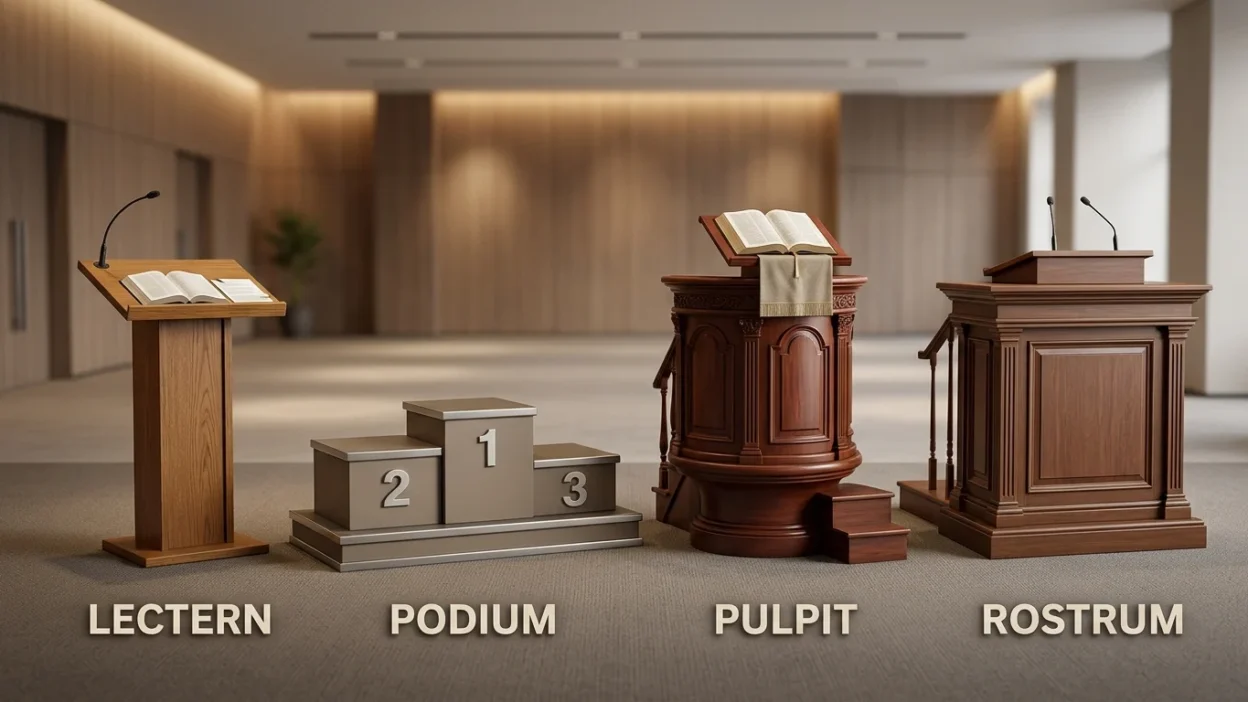
If you have ever wondered about lectern vs. podium vs. pulpit vs. rostrum, you are not alone. These four words describe structures used by people who speak in public, but they do not mean exactly the same thing. A lectern is a stand that holds notes or books, a podium is technically a raised platform for a speaker, a pulpit is a raised stand or enclosed structure used by clergy during religious services, and a rostrum is a platform or stage where someone delivers a speech.
People often confuse these terms because they appear in similar settings, such as classrooms, churches, conferences, and public events. However, understanding their differences helps you choose the correct word in writing and conversation. If you are a student, an ESL learner, or someone preparing a speech, this guide explains each term with simple definitions, practical examples, and easy memory tricks.
Quick Answer: Lectern vs. Podium vs. Pulpit vs. Rostrum
A lectern is a stand that holds a speaker’s notes, while a podium is technically a raised platform. A pulpit is a structure used by religious leaders when preaching. A rostrum is an elevated platform or stage used for public speaking or formal presentations. Although podium and lectern are often used interchangeably in everyday American English, their traditional meanings are different.
Why Do People Confuse Lectern, Podium, Pulpit, and Rostrum?
These four words are confusing because they all relate to public speaking. You might see a speaker standing behind a wooden structure in a church, addressing an audience at a conference, or presenting information in a classroom.
The physical structures may look similar, but their purposes and traditional meanings differ.
Here are the main reasons people mix them up:
- Similar appearance: A lectern, pulpit, and some rostrums can look like standing desks.
- Shared purpose: All four terms can appear in situations involving speeches or presentations.
- Everyday usage: Many Americans use podium when they actually mean lectern.
- Different settings: A pulpit is associated with religious services, while a lectern is common in schools and conferences.
- Overlapping meanings: Rostrum can describe different types of raised speaking platforms.
Understanding the purpose of each structure makes choosing the right word much easier.
What Is a Lectern?
A lectern is a stand with a sloping or flat top designed to hold books, notes, documents, or other reading materials while someone speaks.
It is commonly found in classrooms, lecture halls, conference rooms, and auditoriums. Speakers use lecterns to organize their materials while addressing an audience.
A lectern may be made of wood, metal, acrylic, or another material. Some modern lecterns also include microphones, lighting, and built-in screens.
Lectern as a Part of Speech
Lectern is a noun. It refers to a physical stand used for reading or speaking.
- Singular: Lectern
- Plural: Lecterns
There is no commonly used verb form of lectern.
When Should You Use Lectern?
Use lectern when you are specifically talking about a stand that supports a speaker’s notes or reading materials.
Examples:
- The teacher placed her textbook on the lectern before beginning the lesson.
- The guest speaker stood behind the lectern during the conference.
- A wooden lectern was positioned at the front of the classroom.
- The presenter adjusted the microphone attached to the lectern.
- The student placed her research notes on the lectern before speaking.
Common Places Where Lecterns Are Used
- Schools and universities
- Conference rooms
- Lecture halls
- Auditoriums
- Corporate meeting rooms
- Public speaking events
Speech stand in modern university hall
Clear Acrylic Podium w/ Shelf ¦ Slimline Warehouse
8
What Is a Podium?
A podium is traditionally a raised platform that someone stands on to speak, perform, or receive recognition.
For example, during an awards ceremony, winners may stand on different podium levels to receive medals. At a formal event, a speaker may stand on a podium to address an audience.
However, in everyday American English, podium is also commonly used to describe a lectern. Although this usage is widespread, the traditional distinction remains useful.
Podium as a Part of Speech
Podium is a noun.
- Singular: Podium
- Plural: Podiums or podia
Both plural forms are correct. Podiums is more common in everyday American English.
When Should You Use Podium?
Use podium when referring to a raised platform, especially one designed for a speaker, performer, or award recipient.
Examples:
- The athlete climbed onto the podium to receive her gold medal.
- The speaker stood on the podium to address the audience.
- The winners gathered around the Olympic podium.
- The orchestra conductor stepped onto the podium before the performance.
- The politician delivered his speech from a raised podium.
Common Places Where Podiums Are Used
- Award ceremonies
- Sporting competitions
- Public events
- Graduation ceremonies
- Concert halls
- Formal presentations
SWIMMING-OLY-PARIS-2024-MEDALS
Barack Obama Campaigns Ahead Of Super Tuesday
Stuart Chafetz, conductor — Modesto Symphony Orchestra
6
What Is a Pulpit?
A pulpit is a raised stand, platform, or enclosed structure in a church where a religious leader delivers sermons or addresses the congregation.
It is strongly associated with Christian worship and preaching. Traditional pulpits are often made of wood and may feature decorative carvings, steps, or a railing.
Unlike a general lectern, a pulpit has a specific religious purpose. It represents a place from which a minister, pastor, or preacher delivers a religious message.
Pulpit as a Part of Speech
Pulpit is a noun.
- Singular: Pulpit
- Plural: Pulpits
There is no commonly used verb form of pulpit.
When Should You Use Pulpit?
Use pulpit when referring to a structure associated with preaching or religious speaking.
Examples:
- The pastor walked toward the pulpit before starting the sermon.
- The wooden pulpit stood near the front of the church.
- The minister placed his Bible on the pulpit.
- The congregation listened quietly as the priest spoke from the pulpit.
- The historic church had a beautifully decorated pulpit.
Common Places Where Pulpits Are Used
- Churches
- Chapels
- Cathedrals
- Religious gathering spaces
- Traditional Christian worship settings
Calvary Baptist Church: Riverhead, NY > Sermons
100 Jahre Hauptkirche Sonnborn – Im Schatten der Schwebebahn – Kirchenkreis Wuppertal
8
What Is a Rostrum?
A rostrum is a raised platform or stage used by someone addressing an audience, making a formal announcement, or conducting a public event.
It is commonly associated with formal speeches, ceremonies, debates, and public gatherings.
In some contexts, rostrum can also refer to a lectern or speaking stand. Its exact meaning depends on the setting and regional usage.
The word has historical roots in ancient Rome, where the Rostra was a platform used for public speeches.
Rostrum as a Part of Speech
Rostrum is a noun.
- Singular: Rostrum
- Plural: Rostra or rostrums
Both plural forms are accepted, although rostrums is straightforward in everyday usage.
When Should You Use Rostrum?
Use rostrum when referring to a formal speaking platform or an elevated stage used for public addresses.
Examples:
- The mayor stepped onto the rostrum to deliver an important announcement.
- The speaker addressed the crowd from the university rostrum.
- The debate participants gathered around the rostrum.
- The chairman stood on the rostrum during the formal ceremony.
- The historic building once featured a platform known as a rostrum.
Common Places Where Rostra Are Used
- Political gatherings
- Formal ceremonies
- Public debates
- Universities
- Large meetings
- Historical speaking events
What is a Good Sentence to Start a Speech? Tips for Engaging Your Audience – OMG Hitched!
Akustisch war das Zentrum Roms ein Schwarzes Loch – WELT
6
Lectern vs. Podium vs. Pulpit vs. Rostrum: Comparison Table
The easiest way to understand these four words is to compare their meanings, purposes, and typical settings.
| Feature | Lectern | Podium | Pulpit | Rostrum |
|---|---|---|---|---|
| Main meaning | Reading stand | Raised platform | Religious speaking structure | Speaking platform |
| Primary purpose | Holding notes or books | Elevating a person | Delivering sermons | Addressing an audience |
| Common setting | Classrooms | Events and ceremonies | Churches | Formal gatherings |
| Religious connection | No | No | Yes | No |
| Usually elevated? | Not necessarily | Yes | Often | Usually |
| Part of speech | Noun | Noun | Noun | Noun |
The biggest difference: A lectern holds your materials, a podium raises you above the floor, a pulpit is used for preaching, and a rostrum provides a platform for formal public speaking.
Lectern vs. Podium: What Is the Difference?
The difference between a lectern and a podium is one of the most commonly misunderstood distinctions in American English.
A lectern is a stand that holds notes, books, or documents. A podium is traditionally a raised platform on which a person stands.
For example, a professor may stand behind a lectern while speaking to students. An award winner may stand on a podium while receiving a medal.
However, many Americans use podium to describe the stand behind which a speaker delivers a speech. This everyday meaning is widely understood.
Examples:
- Correct traditional usage: The speaker placed his notes on the lectern.
- Correct traditional usage: The athlete stood on the podium.
- Common American usage: The speaker walked behind the podium.
Lectern vs. Pulpit: What Is the Difference?
A lectern is a general-purpose reading or speaking stand, while a pulpit is specifically associated with religious preaching.
A teacher may use a lectern to present a lesson, but a pastor may use a pulpit to deliver a sermon.
The main difference is the purpose and setting. A pulpit is generally found in religious spaces, whereas a lectern can be used in almost any public speaking environment.
Examples:
- The professor placed her notes on the lectern.
- The pastor delivered his sermon from the pulpit.
Podium vs. Pulpit: What Is the Difference?
A podium is traditionally a raised platform, while a pulpit is a structure used by religious leaders for preaching.
A podium can be found at sports events, award ceremonies, and public gatherings. A pulpit is generally found in churches and other Christian worship spaces.
Although both structures may be elevated, their purposes are different.
Examples:
- The champion stood on the podium to receive her trophy.
- The minister spoke from the pulpit during Sunday worship.
Rostrum vs. Lectern: What Is the Difference?
A rostrum is usually a platform for public speaking, while a lectern is a stand that holds reading materials.
A speaker may stand on a rostrum and use a lectern to hold their speech notes.
This distinction is particularly helpful when describing formal conferences, public debates, and official ceremonies.
Examples:
- The chairman addressed the audience from the rostrum.
- The presenter placed his documents on the lectern.
Rostrum vs. Podium: What Is the Difference?
Rostrum and podium can both refer to raised platforms, but they are not always interchangeable.
A podium is a general term for a raised platform. A rostrum often suggests a platform specifically designed for public speaking or formal addresses.
For example, an athlete receives a medal on a podium, while a politician may deliver a speech from a rostrum.
Examples:
- The athletes climbed onto the podium.
- The president addressed the audience from the rostrum.
Pulpit vs. Rostrum: What Is the Difference?
A pulpit is a religious speaking structure, while a rostrum is a general-purpose platform used for public addresses.
A pastor might preach from a pulpit during a church service. A university speaker might use a rostrum during a formal ceremony.
The key difference is that pulpit has a specific religious association, whereas rostrum is not limited to religious settings.
Examples:
- The preacher stood behind the pulpit.
- The guest speaker stepped onto the rostrum.
When Should You Use Each Word?
Choosing the correct word becomes easier when you consider what the structure does and where it is used.
Use Lectern When:
- Someone needs a stand for notes or books.
- A teacher delivers a classroom lecture.
- A presenter uses a reading stand.
- A speaker needs a place to put documents.
Use Podium When:
- Someone stands on a raised platform.
- An athlete receives a medal.
- A person stands above the surrounding floor.
- A formal event requires an elevated platform.
Use Pulpit When:
- A pastor delivers a sermon.
- A religious leader addresses a congregation.
- A church has a designated preaching structure.
- You are discussing religious speaking traditions.
Use Rostrum When:
- Someone delivers a formal public speech.
- A speaker addresses a large audience from a platform.
- A formal debate or ceremony takes place.
- You are describing a traditional public-speaking platform.
12 Additional Practical Examples of Lectern, Podium, Pulpit, and Rostrum
Here are additional sentences showing how these words work in everyday American English.
- The professor placed her lecture notes on the lectern before entering the classroom.
- The conference organizer installed a new lectern with a built-in microphone.
- The student nervously approached the lectern to present her project.
- The Olympic champion smiled while standing on the podium.
- The conductor stepped onto the podium and raised his hands.
- The winners posed together beside the award podium.
- The pastor opened his Bible while standing at the pulpit.
- The historic church preserved its original wooden pulpit.
- The congregation listened carefully to the minister’s words from the pulpit.
- The speaker climbed onto the rostrum before beginning his address.
- The chairman delivered his opening remarks from the rostrum.
- The university built a new rostrum for formal ceremonies.
Common Mistakes When Using Lectern, Podium, Pulpit, and Rostrum
Even fluent English speakers sometimes use these words incorrectly. The following mistakes are easy to avoid once you understand their meanings.
Mistake 1: Using Podium Instead of Lectern in Formal Writing
Incorrect: The professor placed her textbook on the podium.
Better: The professor placed her textbook on the lectern.
Explanation: Lectern is the more precise word for a stand that holds books or notes. However, podium is common in informal American speech.
Mistake 2: Calling Every Speaking Stand a Pulpit
Incorrect: The conference speaker stood behind the pulpit.
Better: The conference speaker stood behind the lectern.
Explanation: Pulpit is generally associated with religious preaching, not ordinary business presentations.
Mistake 3: Using Lectern for an Elevated Platform
Incorrect: The athlete stood on the lectern to receive her medal.
Better: The athlete stood on the podium to receive her medal.
Explanation: A podium is traditionally a raised platform, while a lectern holds reading materials.
Mistake 4: Using Rostrum for Every Small Reading Stand
Incorrect: The teacher placed her notes on the rostrum.
Better: The teacher placed her notes on the lectern.
Explanation: Lectern is the clearer choice when describing a stand designed to hold documents.
Mistake 5: Assuming Podium and Lectern Always Mean the Same Thing
Incorrect assumption: A podium and a lectern are technically identical.
Better understanding: They have different traditional meanings, although podium is commonly used for a lectern in everyday American English.
An Easy Memory Trick to Remember the Differences
If you struggle to remember these four words, use this simple trick:
- Lectern = Literature: Think of books, notes, and reading materials.
- Podium = Platform: Think of a raised surface where someone stands.
- Pulpit = Preaching: Think of a pastor delivering a sermon.
- Rostrum = Remarks: Think of a formal speech or public address.
Another easy way to remember them is to imagine a speaker at a conference.
The speaker stands on the floor or a raised platform, places notes on a lectern, and delivers remarks to the audience. If the same person were a pastor preaching in a church, the speaking structure might be called a pulpit.
American vs. British English: Are There Any Differences?
The basic meanings of lectern, podium, pulpit, and rostrum are broadly similar in American and British English.
However, there are some differences in everyday usage and preferences.
American English:
- Podium is frequently used informally to mean a speaker’s lectern.
- Lectern is the more precise term for a stand holding notes.
- Podium commonly refers to a raised platform, especially in sports.
British English:
- Lectern is commonly used for a stand holding books or notes.
- Podium refers to a raised platform.
- Rostrum is also used for a platform or stand for public speaking.
The main distinction is not a strict difference between American and British grammar. It is the way speakers choose and use these words in particular situations.
Similar and Related Words
Besides lectern, podium, pulpit, and rostrum, several other English words describe structures or spaces used for speaking.
| Word | Meaning |
|---|---|
| Dais | A raised platform for speakers or honored guests |
| Stage | A raised area for performances or presentations |
| Platform | An elevated surface for standing |
| Stand | A structure that supports something |
| Reading stand | A stand designed to hold reading materials |
| Ambo | A raised stand used for reading scripture in some churches |
| Tribune | A platform or raised speaking area, especially in historical or political contexts |
| Speaker’s stand | A general term for a stand used by a speaker |
These related words can help you describe public speaking environments more accurately.
FAQs:
1. Is a lectern the same as a podium?
Not traditionally. A lectern is a stand that holds books or notes, while a podium is a raised platform. However, Americans commonly use podium to mean a speaker’s stand in everyday conversation.
2. What is the difference between a lectern and a pulpit?
A lectern is a general-purpose stand used for reading or speaking. A pulpit is a religious structure where clergy deliver sermons. Their main difference is their purpose and typical setting.
3. Is a podium the same as a rostrum?
They have overlapping meanings, but they are not always identical. A podium traditionally refers to a raised platform, while a rostrum often describes a platform specifically used for formal public speaking.
4. Why is it called a pulpit?
The word pulpit comes through Latin pulpitum, meaning a platform or stage. Over time, it became associated with the raised structure used by Christian clergy to preach during religious services.
5. Can a lectern be called a rostrum?
Sometimes, particularly in broader or regional usage. However, lectern is more precise when describing a stand that holds notes or books, while rostrum generally suggests a formal speaking platform.
6. What is the plural of podium?
Both podiums and podia are correct plural forms. Podiums is more common in everyday American English, while podia is the traditional Latin-derived plural.
7. What is the plural of rostrum?
The accepted plural forms are rostra and rostrums. Rostrum is a noun, and both plural forms can be used when referring to multiple speaking platforms or structures.
8. Which word should I use for a speaker’s stand at a conference?
Lectern is the most precise word when the structure holds notes, books, or documents. Podium is also widely understood in American English, especially in everyday conversations.
Remember This
- Lectern: A stand for holding books, notes, or documents.
- Podium: A raised platform where someone stands.
- Pulpit: A structure used by religious leaders for preaching.
- Rostrum: A platform used for formal public speaking.
The most important distinction is that a lectern supports reading materials, while a podium supports a person standing on an elevated surface. A pulpit has a religious purpose, and a rostrum is associated with formal addresses.
Conclusion
Understanding lectern vs. podium vs. pulpit vs. rostrum helps you communicate more clearly and choose the right word for different speaking situations. Although these terms sometimes overlap in everyday English, their traditional meanings are distinct. A lectern holds notes, a podium raises a speaker, a pulpit provides a place for preaching, and a rostrum serves as a platform for formal public speaking.
When choosing between these words, think about the structure’s purpose rather than just its appearance. Use lectern for reading materials, podium for a raised platform, pulpit for religious sermons, and rostrum for formal speeches. Remembering these simple differences will help you use all four words confidently in conversations, academic writing, and professional settings.