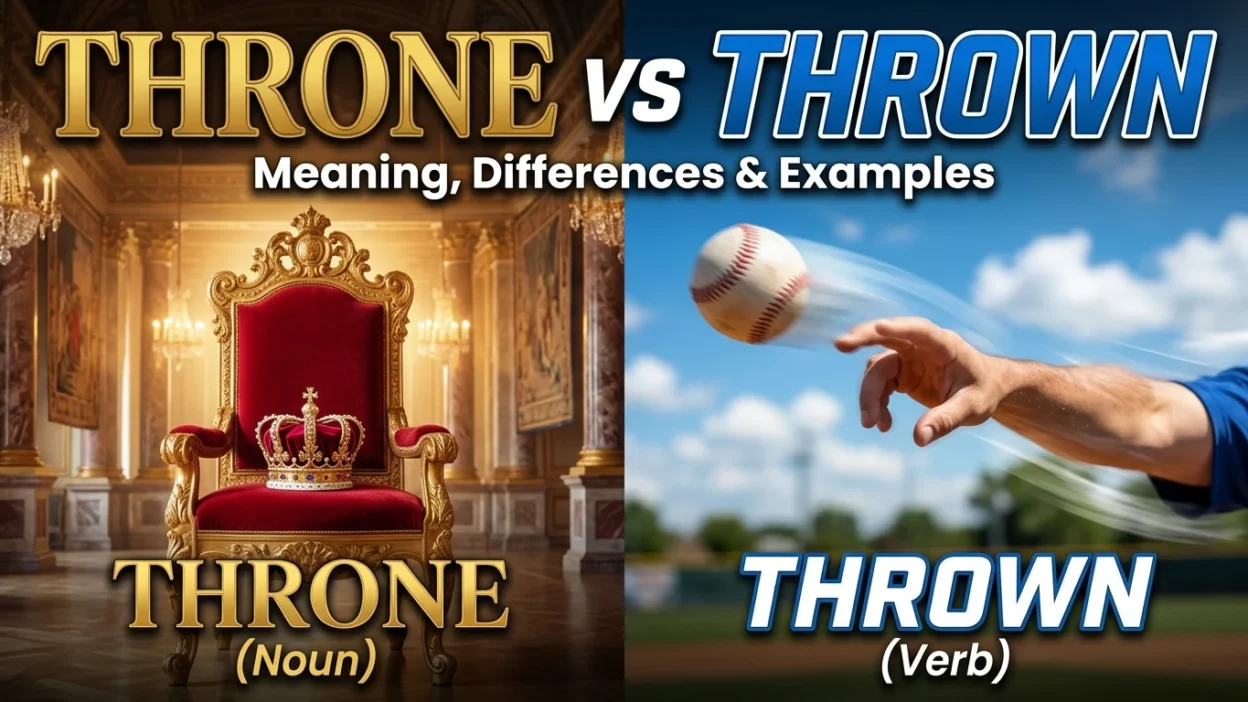
Have you ever wondered if to write throne or thrown? These two words sound exactly alike, but they have completely different meanings, spellings, and grammatical uses. Understanding the difference between throne vs thrown can help you avoid spelling mistakes and communicate more clearly in everyday writing. Although both words are pronounced the same way, one refers to a special seat associated with royalty, while the other describes an action involving something being tossed or propelled through the air.
The confusion usually happens because throne and thrown are homophones, meaning they share the same pronunciation but have different spellings and meanings. However, remembering their individual definitions makes choosing the correct word much easier. If you are a student, an English learner, or someone improving everyday writing skills, this guide explains both words with simple definitions, practical examples, grammar tips, and common mistakes.
Quick Answer: Throne vs Thrown
Throne is a noun that means a special chair occupied by a king, queen, or other ruler. Thrown is the past participle of the verb throw, meaning something has been tossed, hurled, or launched. Both words sound alike, but their meanings and grammatical functions are different.
Why Do People Confuse Throne and Thrown?
People frequently confuse throne and thrown because they are pronounced identically. When spoken aloud, there is no noticeable difference between the two words.
Their similar spelling also contributes to the confusion. Both begin with the letters “thr” and contain the same vowel sound. However, their endings are different: throne ends in “one,” while thrown ends in “own.”
Another reason is that English learners sometimes memorize pronunciation without paying enough attention to spelling or context. Since both words can appear in sentences about kings, stories, sports, and everyday situations, choosing the correct spelling can become challenging.
The easiest way to avoid mistakes is to understand what each word represents.
What Does Throne Mean?
Throne is a noun that refers to a special chair used by a king, queen, emperor, or another important ruler. It often represents royal authority, power, leadership, and sovereignty.
A throne is usually more decorative and impressive than an ordinary chair. It may feature luxurious materials, detailed carvings, gold decorations, and other symbols of royalty.
The word can also have a figurative meaning. For example, someone might use “the throne” to describe a position of great power or authority.
Examples of Throne in Sentences
- The king sat proudly on his golden throne.
- The queen’s throne was decorated with beautiful jewels.
- The prince hoped to inherit the throne one day.
- The royal throne stood in the center of the palace.
- The king gave up his throne after ruling for many years.
Different Uses of the Word Throne
The word throne can appear in several contexts:
- Royalty: The king sat on his throne during the ceremony.
- Leadership: The prince eventually claimed the throne.
- Power: The ruler refused to give up the throne.
- Literature: The hero fought to protect the kingdom’s throne.
- Figurative language: The company founder remained on the throne of the industry.
Grammatical Forms of Throne
Throne is primarily used as a noun.
- Singular: Throne
- Plural: Thrones
- Possessive: Throne’s
- Plural possessive: Thrones’
Examples:
- The throne was made of gold.
- The palace contained several thrones.
- The throne’s design was impressive.
- The thrones’ decorations were different.
What Does Thrown Mean?
Thrown is the past participle of the verb throw. It describes something that has been tossed, hurled, or propelled through the air.
It is commonly used when talking about physical actions, such as throwing a ball, tossing an object, or launching something toward another person.
Thrown can also describe emotional or difficult situations. For example, someone might say they were thrown into a challenging situation when they had little time to prepare.
Unlike throne, thrown is not a noun referring to a chair. It is a verb form that usually appears with helping verbs such as has, have, had, is, or was.
Examples of Thrown in Sentences
- The ball was thrown across the playground.
- She has thrown away her old notebooks.
- The children have thrown their toys on the floor.
- He was thrown into the swimming pool.
- The unexpected news has thrown everyone into confusion.
Different Uses of the Word Thrown
Thrown can be used in different situations:
- Physical action: The boy thrown the ball. (Incorrect; use “The boy threw the ball.”)
- Past participle: The boy has thrown the ball.
- Passive voice: The ball was thrown by the player.
- Emotional confusion: The sudden announcement has thrown me off.
- Unexpected situations: She was thrown into a difficult situation.
Grammatical Forms of Thrown
Thrown belongs to the verb throw.
Its main grammatical forms are:
| Verb form | Word |
|---|---|
| Base form | Throw |
| Third-person singular | Throws |
| Simple past | Threw |
| Past participle | Thrown |
| Present participle | Throwing |
Examples:
- I throw the ball every afternoon.
- She throws the ball accurately.
- He threw the ball yesterday.
- They have thrown the ball several times.
- The children are throwing snowballs.
Throne vs Thrown: Key Differences
Although throne and thrown sound identical, their meanings, grammatical roles, and sentence structures are different.
| Feature | Throne | Thrown |
|---|---|---|
| Meaning | A special royal chair | Tossed or propelled |
| Part of speech | Noun | Past participle of a verb |
| Root word | Throne | Throw |
| Pronunciation | /θroʊn/ | /θroʊn/ |
| Plural form | Thrones | No regular plural |
| Main association | Royalty and authority | Movement and action |
| Example | The king sat on his throne. | The ball was thrown outside. |
The biggest difference is that throne names something, while thrown describes an action or the result of an action.
When Should You Use Throne?
Use throne when discussing a special seat associated with royalty, leadership, or authority.
Here are situations where throne is the correct choice:
1. Talking About Kings and Queens
Use throne when describing the special chair occupied by a royal ruler.
Example: The queen sat on her throne during the celebration.
2. Discussing Royal Authority
Throne can represent a ruler’s position or power.
Example: The young prince inherited the throne after his father’s death.
3. Writing Historical Stories
When describing royal families, kingdoms, or historical events, throne is often appropriate.
Example: The king defended his throne against his enemies.
4. Using Figurative Language
Throne can represent an influential position or powerful status.
Example: The champion remained on his throne for several years.
When Should You Use Thrown?
Use thrown when describing something that has been tossed, launched, or moved through the air.
Here are common situations where thrown is correct:
1. Describing a Physical Action
Use thrown when something has been tossed by someone.
Example: The ball was thrown toward the goal.
2. Using Perfect Tenses
Thrown commonly appears with has, have, or had.
Example: She has thrown the letter into the trash.
3. Writing Passive Sentences
Use thrown when the subject receives the action.
Example: The stone was thrown into the river.
4. Describing Confusion or Surprise
Thrown can describe a situation that makes someone confused or unprepared.
Example: His unexpected question threw me off.
10+ Practical Examples of Throne vs Thrown
Understanding both words becomes easier when you compare them in everyday sentences.
- Throne: The king returned to his throne after the battle.
- Thrown: The soldier had thrown his weapon aside.
- Throne: The royal throne was covered in gold.
- Thrown: The children have thrown snowballs at each other.
- Throne: The princess wanted to protect her family’s throne.
- Thrown: The package was thrown onto the porch.
- Throne: The ancient throne is displayed in the museum.
- Thrown: Someone had thrown a stone through the window.
- Throne: The king’s throne represented his authority.
- Thrown: The player has thrown the ball out of bounds.
- Throne: The prince finally claimed the throne.
- Thrown: The unexpected result has thrown the team into confusion.
Common Mistakes When Using Throne and Thrown
Even experienced English speakers sometimes make mistakes with homophones. Here are some common errors and their corrections.
Mistake 1: Using Throne Instead of Thrown
Incorrect: The ball was throne into the garden.
Correct: The ball was thrown into the garden.
Why? The sentence describes an action involving a ball, so thrown is the correct word.
Mistake 2: Using Thrown Instead of Throne
Incorrect: The king sat on his thrown.
Correct: The king sat on his throne.
Why? The sentence refers to a royal chair, so throne is necessary.
Mistake 3: Writing Thrown as the Simple Past Tense
Incorrect: He thrown the ball yesterday.
Correct: He threw the ball yesterday.
Why? Threw is the simple past form of throw. Thrown is the past participle.
Mistake 4: Using Throne as a Verb
Incorrect: She throne the paper away.
Correct: She threw the paper away.
Why? Throne is a noun, not a verb. Threw is the correct simple past form.
Mistake 5: Confusing Their Meanings in Formal Writing
Incorrect: The prince was thrown to the throne after his father’s death.
Correct: The prince was placed on the throne after his father’s death.
Why? The intended meaning concerns royal authority rather than tossing someone.
Easy Memory Trick to Remember Throne vs Thrown
A simple memory trick can help you choose the correct spelling every time.
Throne = Royal Chair
Remember the word “king” or “queen.” If your sentence involves royalty, a palace, or a ruler’s special seat, use throne.
Thrown = Something Tossed
Remember the verb “throw.” If your sentence describes something being tossed, launched, or hurled, use thrown.
You can also remember this simple rule:
- Throne has an “e” like the word seat in its meaning.
- Thrown comes from throw, and both describe an action involving tossing.
Whenever you are unsure, think about the meaning of your sentence instead of relying on pronunciation.
Throne vs Thrown in American and British English
There is no meaningful spelling or usage difference between throne and thrown in American and British English.
Both varieties use throne for a royal chair and thrown as the past participle of throw.
Their pronunciation is also generally the same within each variety, although accents can create slight differences in how vowel sounds are produced.
Examples:
- American English: The king sat on his throne.
- British English: The king sat on his throne.
- American English: The ball was thrown into the field.
- British English: The ball was thrown into the field.
Therefore, you do not need to learn separate American and British spellings for these words.
Similar and Related Words
Learning related words can help you understand the difference between throne and thrown more clearly.
Words Related to Throne
- Royalty: People belonging to a royal family.
- Monarch: A king, queen, or other sovereign ruler.
- Kingdom: A country or territory ruled by a king or queen.
- Crown: A decorative headpiece worn by a monarch.
- Sovereignty: Supreme authority or power.
- Palace: A large and impressive royal residence.
Words Related to Thrown
- Throw: To send something through the air using force.
- Threw: The simple past tense of throw.
- Tossed: Thrown lightly or casually.
- Hurled: Thrown with great force.
- Launched: Sent something into motion.
- Cast: Thrown or sent in a particular direction.
These related words make it easier to recognize if a sentence discusses royalty or an action involving movement.
FAQs:
1. What is the main difference between throne and thrown?
Throne is a noun referring to a special chair used by a king, queen, or ruler. Thrown is the past participle of throw, describing something that has been tossed or propelled through the air.
2. Are throne and thrown pronounced the same?
Yes. Throne and thrown are homophones, meaning they have the same pronunciation but different spellings and meanings. Both are generally pronounced /θroʊn/ in American English.
3. Is throne a noun or a verb?
Throne is primarily a noun. It refers to a royal chair or, figuratively, a position of authority. Its plural form is thrones. It is not the past tense or past participle of throw.
4. Is thrown the past tense of throw?
No. Thrown is the past participle of throw. The simple past tense is threw. For example, “I threw the ball yesterday” and “I have thrown the ball before” are both grammatically correct.
5. How do you use thrown in a sentence?
You can use thrown to describe something that has been tossed or launched. For example, “The ball was thrown across the field.” It also appears in perfect tenses, such as “She has thrown away the old papers.”
6. Why do people confuse throne and thrown?
People confuse these words because they sound exactly alike and have similar spellings. However, their meanings are different. Remembering that throne means a royal chair and thrown describes an action helps prevent spelling errors.
7. Which word should I use: throne or thrown?
Choose throne when referring to a royal seat, a king’s authority, or a position of power. Choose thrown when describing something that has been tossed, hurled, or launched. Always consider the context of your sentence.
Remember This: Throne vs Thrown
Here is the easiest way to remember the difference:
- Throne: A special chair associated with kings, queens, and royalty.
- Thrown: The past participle of throw, meaning tossed or propelled.
- Threw: The simple past tense of throw.
- Thrones: The plural form of throne.
Remember that throne is connected to royalty, while thrown is connected to the action of throwing. Although these words sound alike, they cannot be used interchangeably.
Conclusion
Understanding the difference between throne vs thrown is simple once you learn their meanings and grammatical roles. Throne is a noun that refers to a royal chair or a position of authority, whereas thrown is the past participle of the verb throw. Both words have identical pronunciations, but their spellings and uses are completely different.
To avoid confusion, remember that a king or queen sits on a throne, while a ball can be thrown across a field. Pay attention to the context, use the correct verb forms, and practice with everyday examples. With these simple rules, you can confidently use throne and thrown in your speaking and writing.