
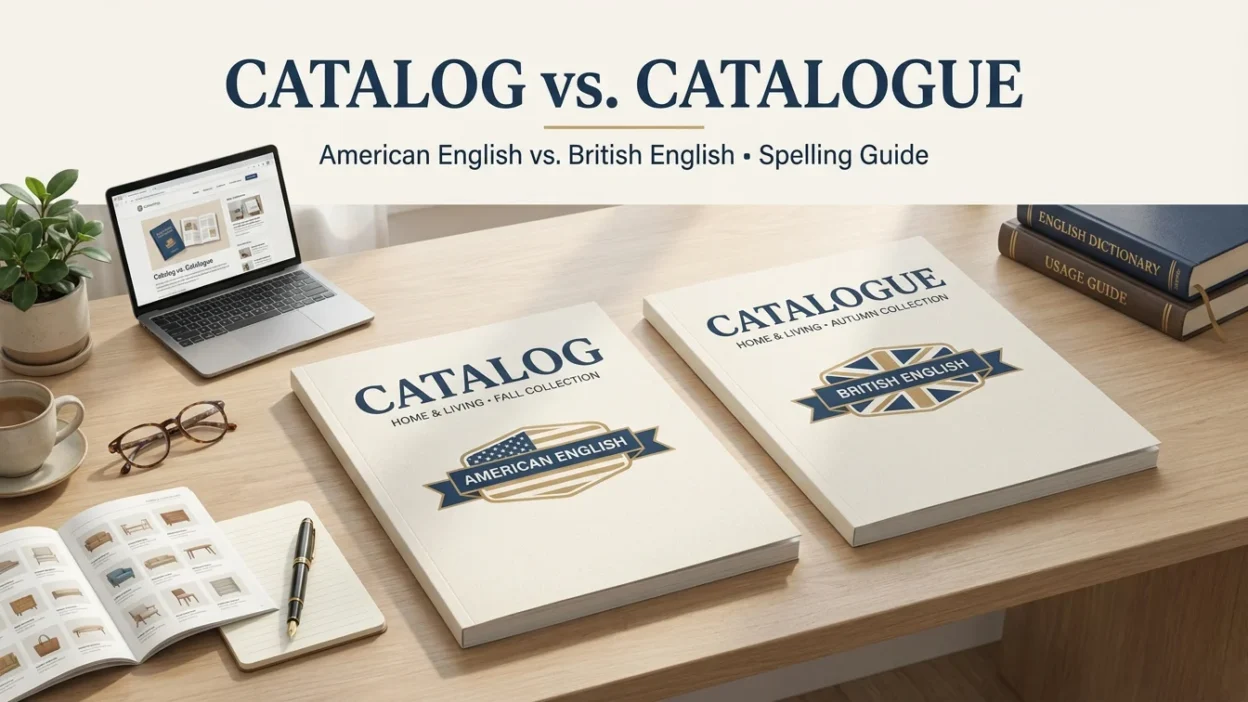
If you are wondering if catalog or catalogue is correct, both spellings are acceptable English. The difference is mainly regional. Catalog is the standard spelling in American English, while catalogue is more commonly used in British English and other English-speaking countries. Both words have the same meaning and can be used as nouns or verbs.
A catalog or catalogue is an organized list of items, products, books, courses, artwork, or other information. You might see the word in a shopping catalog, library catalog, university catalog, or digital catalog. Although the two spellings are interchangeable in meaning, choosing the spelling that matches your audience makes your writing more consistent and natural.
Quick Answer: Catalog or Catalogue?
Catalog is the preferred spelling in American English, while catalogue is the traditional British English spelling. Both are correct and have the same meaning. If you are writing for American readers, use catalog. If you are writing in British English, catalogue is generally preferred.
What Is the Difference Between Catalog and Catalogue?
The difference between catalog and catalogue is spelling, not meaning. Both words describe an organized list of items or the process of recording and organizing information.
- Catalog: American English spelling.
- Catalogue: British English spelling.
Both forms can function as nouns and verbs. The spelling you choose depends on your preferred English variety, your audience, and the style guide you follow.
What Does Catalog Mean?
Catalog is a noun or verb that refers to an organized list of items or the process of arranging, recording, or describing items systematically.
Catalog as a noun
As a noun, catalog refers to a collection of information about products, books, services, courses, or other items.
Examples include:
- A product catalog listing items for sale.
- A library catalog containing information about books.
- A course catalog describing academic programs.
- A museum catalog documenting artwork.
- An online catalog showing available products.
Examples:
- I ordered a sofa from the furniture catalog.
- The library catalog helped me find the book.
- The university published its new course catalog.
- You can browse the product catalog online.
- The museum created a catalog of its paintings.
Catalog as a verb
As a verb, catalog means to organize, record, list, or describe items systematically.
Examples:
- The librarian cataloged the new books.
- We catalog every product in our inventory.
- The researchers cataloged the plant species.
- She cataloged her collection of vintage photographs.
- The company cataloged its records before moving offices.
What Does Catalogue Mean?
Catalogue has the same meaning as catalog. It is the spelling commonly preferred in British English and many other English-speaking countries.
Catalogue as a noun
Catalogue refers to an organized list or collection of information about items, products, books, or services.
Examples:
- I received a clothing catalogue in the mail.
- The museum printed a catalogue of its collection.
- She searched the library catalogue for the novel.
- The company released a new product catalogue.
- The college published its course catalogue.
Catalogue as a verb
Catalogue also means to organize, record, or list information systematically.
Examples:
- The librarian catalogued the donated books.
- They catalogued the historical documents.
- The staff catalogued all the museum objects.
- She catalogued her old family photographs.
- The researchers catalogued the samples carefully.
Catalog vs. Catalogue: Comparison Table
| Feature | Catalog | Catalogue |
|---|---|---|
| Preferred region | American English | British English |
| Meaning | Organized list or record | Organized list or record |
| Part of speech | Noun and verb | Noun and verb |
| Plural noun | Catalogs | Catalogues |
| Past tense | Cataloged | Catalogued |
| Present participle | Cataloging | Cataloguing |
| Example | Product catalog | Product catalogue |
| Correctness | Correct | Correct |
Catalog vs. Catalogue: Parts of Speech and Grammar
Both words can be used as nouns and verbs. Their grammatical roles remain the same regardless of which spelling you choose.
1. Noun
A noun refers to a collection or organized list of items.
- The catalog is available online.
- The catalogue contains hundreds of products.
2. Verb
A verb describes the action of creating, maintaining, or organizing a list or record.
- We catalog books every week.
- They catalogue historical documents.
3. Plural forms
When referring to more than one list:
- American English: catalogs
- British English: catalogues
Examples:
- The store printed three catalogs.
- The museums published separate catalogues.
4. Past tense
When describing an action completed in the past:
- American English: cataloged
- British English: catalogued
Examples:
- She cataloged the inventory yesterday.
- He catalogued the collection last month.
5. Present participle
When describing an ongoing action:
- American English: cataloging
- British English: cataloguing
Examples:
- We are cataloging the new products.
- They are cataloguing the archived documents.
When Should You Use Catalog?
Use catalog when writing in American English, especially for business, education, shopping, libraries, and everyday communication.
Common situations for using catalog:
- Product lists and shopping publications
- Library records
- University course listings
- Online product collections
- Business inventories
- Digital databases
Examples of catalog in sentences
- The company sent me its latest catalog.
- You can find the item in our online catalog.
- The school updated its course catalog.
- I browsed the catalog before placing my order.
- The librarian cataloged all the new arrivals.
When Should You Use Catalogue?
Use catalogue when writing in British English or when a publication, organization, or style guide specifically prefers that spelling.
Common situations for using catalogue:
- British publications
- UK business documents
- British university materials
- Museums and art collections
- International writing that follows British spelling conventions
Examples of catalogue in sentences
- The shop published its new catalogue.
- I found the painting in the museum catalogue.
- The university catalogue lists all degree programs.
- She ordered a dress from the online catalogue.
- The archivist catalogued the historical records.
10+ Practical Examples of Catalog vs. Catalogue
Both spellings can be used in the following sentences without changing their meaning. The examples use American spelling first.
| American English | British English |
|---|---|
| The catalog is available online. | The catalogue is available online. |
| I received a catalog yesterday. | I received a catalogue yesterday. |
| The library catalog is easy to search. | The library catalogue is easy to search. |
| We updated our product catalog. | We updated our product catalogue. |
| She cataloged the new books. | She catalogued the new books. |
| They are cataloging the records. | They are cataloguing the records. |
| The catalogs arrived this morning. | The catalogues arrived this morning. |
| Please check the catalog for details. | Please check the catalogue for details. |
| The company printed several catalogs. | The company printed several catalogues. |
| He cataloged the museum’s collection. | He catalogued the museum’s collection. |
| The online catalog contains useful information. | The online catalogue contains useful information. |
| We are cataloging old photographs. | We are cataloguing old photographs. |
Why Do People Confuse Catalog and Catalogue?
People confuse catalog and catalogue because the words:
- Have the same pronunciation in most English varieties.
- Have exactly the same meaning.
- Are both grammatically correct.
- Differ only in spelling.
- Follow different regional spelling conventions.
Many American English words have simplified spellings that omit the ending -ue, while British English often retains it. This pattern is also seen in words such as dialog and dialogue.
Common Mistakes With Catalog and Catalogue
Mistake 1: Thinking catalogue is incorrect
Correct: The museum published a catalogue of its artwork.
Catalogue is a correct spelling. It is simply more common in British English.
Mistake 2: Thinking catalog is informal
Correct: The university released its official catalog.
Catalog is perfectly acceptable in professional, academic, and formal American writing.
Mistake 3: Mixing spelling conventions
Less consistent: The company catalogued its products and updated the color catalogue.
More consistent American English: The company cataloged its products and updated the color catalog.
Try to follow one spelling convention throughout the same document.
Mistake 4: Using the wrong verb form
Correct American English: She cataloged the books.
Correct British English: She catalogued the books.
Both are correct when used according to their respective spelling conventions.
Easy Memory Trick
Remember this simple trick:
- Catalog = America: The shorter spelling is standard in American English.
- Catalogue = British: The longer spelling is traditionally preferred in British English.
If you’re writing for a US audience, choose catalog, cataloged, and cataloging. This will help you keep your spelling consistent.
American vs. British English: Catalog or Catalogue?
The spelling difference is genuine and reflects regional English conventions.
| American English | British English |
|---|---|
| Catalog | Catalogue |
| Catalogs | Catalogues |
| Cataloged | Catalogued |
| Cataloging | Cataloguing |
In American English, catalog is widely used in everyday, academic, and business writing. In British English, catalogue is generally preferred, although catalog is also recognized.
Neither spelling is more intelligent, formal, or grammatically correct than the other. Both are accepted English.
Similar and Related Words
Here are some words related to catalog and catalogue:
- Inventory: A detailed list of goods, materials, or items available or owned.
- Directory: An organized list of people, organizations, locations, or resources.
- Register: An official or systematic record of information.
- Index: A list that helps readers locate information within a document or collection.
- List: A collection of items written or arranged in order.
- Database: An organized collection of information stored for easy access and management.
- Archive: A collection of historical records or documents preserved for reference.
- Collection: A group of items gathered together for a particular purpose.
These words are related but are not always interchangeable. For example, an inventory usually tracks items or quantities, while a catalog often provides descriptive information to help people identify or find items.
FAQs:
1. Is catalog or catalogue correct?
Both catalog and catalogue are correct spellings. Catalog is the standard spelling in American English, while catalogue is generally preferred in British English. They have the same meaning and can be used as nouns or verbs.
2. Is catalog American or British English?
Catalog is primarily associated with American English. American writers commonly use catalog, catalogs, cataloged, and cataloging, while British writers generally prefer catalogue, catalogues, catalogued, and cataloguing.
3. Is catalogue British spelling?
Yes, catalogue is traditionally the British English spelling. It is commonly used in the UK, Australia, and other regions that follow British spelling conventions, although catalog is also recognized.
4. Is catalog more correct than catalogue?
No. Catalog is not more correct than catalogue, and catalogue is not more correct than catalog. Both spellings are acceptable. Your choice should depend on your audience, regional spelling convention, or the style guide you are following.
5. Is it cataloging or cataloguing?
Both are correct. Cataloging is the standard American spelling, while cataloguing is the traditional British spelling. Both describe the process of organizing or recording items in a systematic list.
6. Is it cataloged or catalogued?
Both spellings are correct. Cataloged is the American English form, and catalogued is the British English form. They are both past-tense forms of the verb catalog or catalogue.
7. Should I use catalog or catalogue in academic writing?
If you are writing for an American university, journal, or audience, catalog is generally the better choice. If your institution follows British English, catalogue may be preferred. Always follow your institution’s writing guidelines when available.
Remember This
- Catalog is the preferred American English spelling.
- Catalogue is the traditional British English spelling.
- Both words have the same meaning.
- Both can be nouns or verbs.
- Catalog, cataloged, and cataloging are common American forms.
- Catalogue, catalogued, and cataloguing are common British forms.
- Consistency matters more than choosing one spelling over the other.
Conclusion
Catalog and catalogue are two correct spellings of the same word. They refer to an organized list of items, products, books, records, or information, and both can also describe the act of organizing or recording those items. The difference is regional rather than grammatical or meaningful.
For American readers, catalog is the best choice because it follows standard American English spelling. If you are writing for British readers, catalogue is generally the more natural option. Choose the spelling that suits your audience, use it consistently, and you will be correct either way.