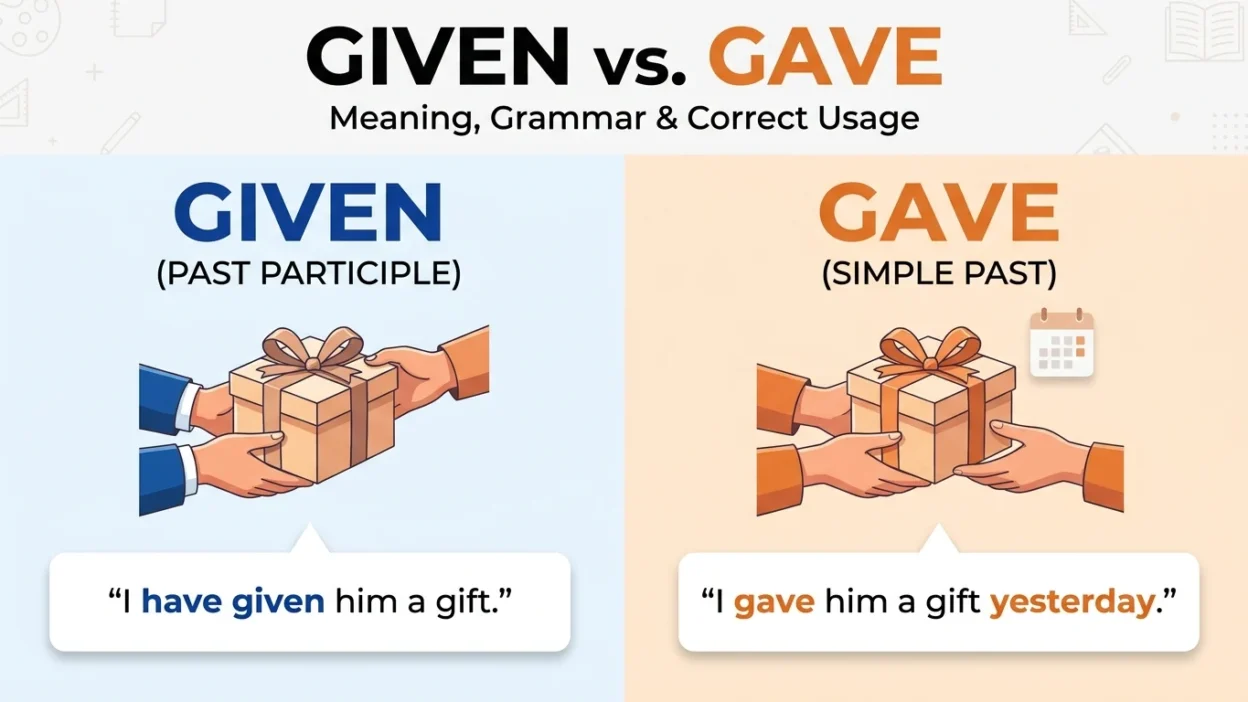
Understanding the difference between given vs. gave can help you speak and write English more accurately. Although both words come from the verb give, they serve different grammatical purposes. Gave is the simple past tense of give, while given is the past participle, which is usually used with helping verbs such as have, has, and had. For example, you can say, “She gave me a present yesterday” or “She has given me a present.” Both sentences describe an act of giving, but their grammatical structures are different.
Many English learners confuse these words because they describe the same basic action. However, using one instead of the other can make a sentence grammatically incorrect. If you are writing an email, having a conversation, or completing an English grammar exercise, knowing when to use given and gave will make your communication clearer. This guide explains their meanings, differences, examples, and common mistakes in simple American English.
Quick Answer: Given vs. Gave
Gave is the simple past tense of give and describes an action completed in the past. Given is the past participle of give and generally appears with helping verbs such as have, has, and had. Say “I gave him a book” but “I have given him a book.”
Why Do People Confuse Given and Gave?
People often confuse given and gave because both are forms of the irregular verb give. They refer to the same action but follow different grammatical rules.
The main difference is how they work in a sentence:
- Gave: Describes a completed action in the past.
- Given: Works with helping verbs to form perfect tenses or appears in passive constructions.
For example:
- Correct: She gave me a beautiful gift.
- Correct: She has given me a beautiful gift.
- Incorrect: She has gave me a beautiful gift.
The confusion usually happens when learners memorize the meaning of a word without understanding its tense and grammatical function.
What Does Given Mean?
Given is the past participle of the verb give. It describes an action of giving when used with auxiliary verbs or in passive voice.
It can also function as an adjective or preposition in certain contexts.
Definition of Given
Given means having been handed, provided, offered, or granted to someone.
It is commonly used with helping verbs such as:
- Have
- Has
- Had
- Was
- Were
- Is
- Are
Examples:
- I have given him three opportunities to improve.
- She has given me excellent advice.
- They had given their approval before the meeting.
- The students were given extra time to finish the test.
- He has given everything he can to this project.
When to Use Given
Use given in the following situations:
1. With Have, Has, or Had
Use given when forming the present perfect or past perfect tense.
Examples:
- I have given you enough time.
- She has given her answer.
- They had given us permission.
2. In Passive Voice
Use given when someone receives something, rather than focusing on the person performing the action.
Examples:
- The award was given to the winner.
- Each student was given a certificate.
- The employees were given additional responsibilities.
3. As an Adjective
Given can describe something specified, assumed, or already established.
Examples:
- At any given moment, something can change.
- Under the given circumstances, we made the best decision.
- Please complete the task within the given time.
4. As a Preposition
Given can mean considering or taking something into account.
Examples:
- Given his experience, he is the right person for the job.
- Given the weather, we should stay inside.
What Does Gave Mean?
Gave is the simple past tense of the verb give. It describes an action that happened and was completed in the past.
Unlike given, gave does not normally require a helping verb to express the simple past tense.
Definition of Gave
Gave means handed, provided, offered, or transferred something to another person in the past.
Examples:
- My father gave me a new bicycle.
- She gave her friend a birthday card.
- They gave us useful information yesterday.
- He gave his teacher the completed assignment.
- I gave my brother some money.
When to Use Gave
Use gave when talking about a completed action in the past.
1. For Completed Past Actions
Examples:
- I gave him my phone number yesterday.
- She gave me a wonderful surprise.
- We gave them our final decision.
2. With Specific Past Time Expressions
Gave often appears with expressions that identify when an action happened.
Examples:
- He gave me a call last night.
- They gave us the results two days ago.
- My teacher gave me feedback last Monday.
3. In Past-Time Stories
Use gave when describing events that happened in the past.
Examples:
- The old man gave the child a small gift.
- She gave him a chance to explain.
- My mother gave me some helpful advice.
Given vs. Gave: Key Differences
Although given and gave come from the same verb, their grammatical functions are different.
| Feature | Given | Gave |
|---|---|---|
| Base verb | Give | Give |
| Grammatical form | Past participle | Simple past |
| Main purpose | Perfect tenses and passive voice | Completed past actions |
| Helping verbs | Have, has, had, was, were | Not normally needed |
| Example | I have given my answer. | I gave my answer. |
| Can stand alone as a simple past verb? | No | Yes |
| Adjective use | Yes | No |
The easiest way to understand the difference is to remember that gave expresses a past action independently, while given usually needs grammatical support.
Give vs. Gave vs. Given: Understanding All Three Forms
To use given and gave correctly, you should also understand the base form of the verb.
The verb give has three important forms:
| Verb Form | Word | Example |
|---|---|---|
| Base form | Give | I give him advice. |
| Simple past | Gave | I gave him advice. |
| Past participle | Given | I have given him advice. |
Here is how each form works:
- Give: Used in the present tense, commands, and after certain helping verbs.
- Gave: Used for completed actions in the past.
- Given: Used with perfect-tense helping verbs and in passive constructions.
More examples:
- I give my children gifts every year.
- I gave my children gifts last year.
- I have given my children gifts many times.
Given vs. Gave in Different Tenses
Understanding verb tenses makes it easier to choose between these two words.
Simple Past Tense
Use gave to describe a completed past action.
Example: She gave me a beautiful necklace yesterday.
Present Perfect Tense
Use given with have or has to describe an action connected to the present.
Example: She has given me several useful suggestions.
Past Perfect Tense
Use given with had to describe an action completed before another past event.
Example: She had given me the information before I asked.
Passive Voice
Use given with an appropriate form of the verb be.
Example: The children were given new books.
15 Practical Examples of Given vs. Gave
These examples show how the two words work in everyday American English.
Examples Using Given
- I have given you several chances to succeed.
- She has given me a reason to smile.
- They had given their approval before the event.
- The teacher has given us extra homework.
- He was given an opportunity to speak.
- We have given our best effort.
- Each participant was given a certificate.
- Given the situation, I think we should wait.
Examples Using Gave
- My sister gave me a beautiful birthday present.
- He gave his seat to an alternative woman.
- I gave her the keys this morning.
- They gave us directions to the restaurant.
- The manager gave everyone a day off.
- My parents gave me helpful advice.
- She gave him a second chance.
Common Mistakes When Using Given and Gave
Even experienced English learners sometimes make mistakes with these words. Here are some common errors and their corrections.
Mistake 1: Using Gave After Have
Incorrect: I have gave him my phone number.
Correct: I have given him my phone number.
Explanation: Use the past participle given after have.
Mistake 2: Using Gave After Has
Incorrect: She has gave me a gift.
Correct: She has given me a gift.
Explanation: Has must be followed by the past participle in the present perfect tense.
Mistake 3: Using Gave After Had
Incorrect: They had gave us enough time.
Correct: They had given us enough time.
Explanation: The past perfect tense requires had + past participle.
Mistake 4: Using Given Without a Helping Verb
Incorrect: He given me a book yesterday.
Correct: He gave me a book yesterday.
Explanation: Use gave for a simple past action.
Mistake 5: Confusing Passive Voice
Incorrect: The students were gave new books.
Correct: The students were given new books.
Explanation: Passive voice uses the appropriate form of be followed by the past participle.
An Easy Memory Trick for Given vs. Gave
Remember this simple rule:
Gave = Past action.
Given = Past participle.
You can also memorize these two sentence patterns:
- Yesterday, I gave him a gift.
- I have given him a gift.
Whenever you see have, has, or had, remember that you generally need given rather than gave.
This simple trick can help you avoid most common grammatical mistakes.
Are Given and Gave Different in American and British English?
No. There is no meaningful difference between American and British English regarding the grammatical use of given and gave.
Both varieties use:
- Give as the base form.
- Gave as the simple past tense.
- Given as the past participle.
For example:
- American English: I gave her a book.
- British English: I gave her a book.
Both versions are grammatically correct. The same rule applies to sentences using given.
Similar and Related Words
Learning related verb forms can help you understand irregular verbs and improve your English grammar.
Here are some useful examples:
| Base Form | Simple Past | Past Participle |
|---|---|---|
| Give | Gave | Given |
| Take | Took | Taken |
| Write | Wrote | Written |
| Eat | Ate | Eaten |
| Break | Broke | Broken |
| Speak | Spoke | Spoken |
| Drive | Drove | Driven |
| See | Saw | Seen |
| Choose | Chose | Chosen |
| Know | Knew | Known |
Notice that these verbs also have different simple past and past participle forms.
For example:
- I took the book yesterday.
- I have taken the book already.
- She wrote a letter last night.
- She has written three letters.
Understanding these patterns makes it easier to learn given and gave.
When Should You Use Given or Gave?
Here is a quick guide to help you choose the correct word in everyday writing and conversation.
Use gave when:
- You describe something that happened in the past.
- You mention a completed action with a specific past time.
- You do not need a helping verb to express the past action.
Use given when:
- You use have, has, or had.
- You construct a passive sentence.
- You use the word as an adjective or in a phrase such as “given the circumstances.”
FAQs:
1. Is It Given or Gave?
Both words are correct, but they have different grammatical uses. Gave is the simple past tense of give, while given is the past participle. Use “I gave him a gift” and “I have given him a gift.”
2. Is Given the Past Tense of Give?
No. Given is the past participle of give, not its simple past tense. The simple past form is gave. For example, “I gave her a book yesterday” is correct, while “I have given her a book” uses the past participle correctly.
3. Can I Say “I Have Gave”?
No. “I have gave” is grammatically incorrect in standard English. The correct expression is “I have given.” This is because the present perfect tense follows the structure have or has + past participle.
4. Is It “Had Given” or “Had Gave”?
The correct expression is “had given.” The past perfect tense requires had followed by the past participle of the main verb. For example, “She had given me the answer before the meeting started.”
5. Is “Was Given” Grammatically Correct?
Yes. “Was given” is grammatically correct because it uses passive voice. It describes something received by a person. For example, “He was given an award for his excellent performance.”
6. What Are the Three Forms of Give?
The three main forms of give are give, gave, and given. Give is the base form, gave is the simple past tense, and given is the past participle. These forms are used in different grammatical structures.
7. Can Given Be Used Without Have, Has, or Had?
Yes. Given can appear without these helping verbs when it functions as an adjective, in passive constructions, or as a preposition. Examples include “the given information,” “was given a prize,” and “given the circumstances.”
Remember This
- Give is the base form.
- Gave is the simple past tense.
- Given is the past participle.
- Use gave for completed past actions.
- Use given after have, has, and had.
- Use given in passive constructions such as “was given.”
- Given can also function as an adjective or preposition.
Conclusion
Understanding the difference between given and gave is an important part of learning correct English grammar. Although both words come from the verb give, they serve different purposes. Gave describes a completed action in the past, while given is the past participle used in perfect tenses and passive voice. Remembering these basic rules will help you avoid common mistakes and communicate more confidently.
The best way to master these words is to practice using them in everyday sentences. Remember the patterns “I gave him a book” and “I have given him a book.” Once you understand how these structures work, choosing between given and gave becomes much easier. Keep practicing, and you will gradually use both forms naturally in your speaking and writing.

Julian Carter is a writer, poet, and scholar whose work explores culture, identity, history, and human connection. Through thoughtful storytelling and creative insight, he inspires readers to reflect on relationships, memory, and personal transformation.