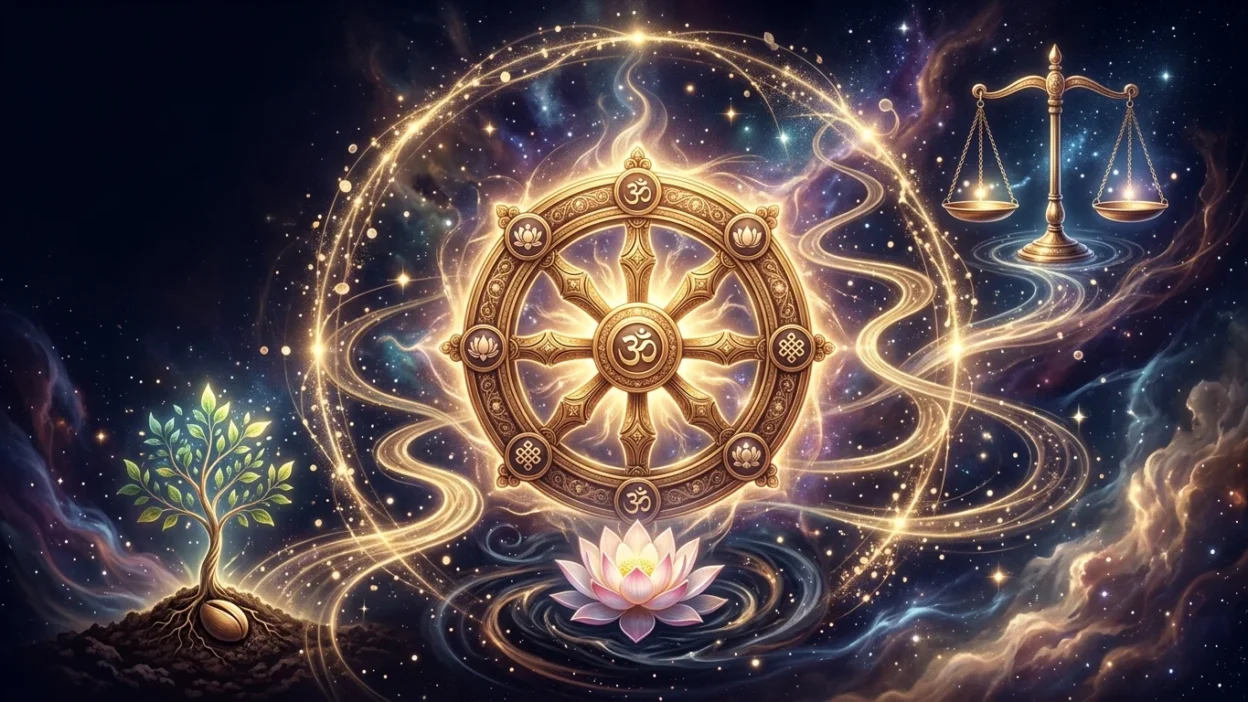
Karma symbolism is connected with the idea that our actions, intentions, and choices can create consequences that eventually return to us. The concept is often represented through cycles, balance, circles, seeds, scales, and other symbols that suggest cause and effect.
Understanding karma symbolism can help us explore deeper ideas about personal responsibility, spiritual growth, justice, relationships, and life lessons. If you notice karmic symbols in dreams, artwork, religion, tattoos, or everyday life, they can encourage you to think about how your choices shape your journey.
1. Karma Symbolism and the Circle of Life
The circle is one of the clearest symbols associated with karma because it represents cycles, continuity, and the return of energy. It suggests that actions can create patterns that come back into our lives.
Best for: Understanding cycles and repeated life experiences.
Alternative: Spiral symbolism can represent growth within a cycle.
Examples:
A person repeatedly experiencing the same relationship pattern may see it as a karmic cycle.
A circular design in spiritual artwork can represent the continuing cycle of actions and consequences.
2. Karma Symbolism and Cause and Effect
At its heart, karma symbolism represents cause and effect. It reminds us that choices can produce consequences, if those consequences are immediate or develop over time.
Best for: Reflecting on personal responsibility.
Alternative: The domino effect is a simple modern metaphor.
Examples:
Helping someone may inspire them to help another person later.
Repeated dishonesty can gradually damage trust in relationships.
3. Karma Symbolism in Spirituality
In spiritual traditions, karma is often connected with intention, action, learning, and personal development. Its symbolism can encourage people to become more conscious of how they treat themselves and others.
Best for: Spiritual reflection and self-awareness.
Alternative: Soul-growth symbolism offers a related interpretation.
Examples:
Meditating on past choices can encourage greater awareness.
A spiritual journal can help someone recognize recurring behavioral patterns.
4. Karma Symbolism and Balance
Balance is an important karmic theme. Karma symbolism can suggest that life contains a natural movement toward accountability and equilibrium.
Best for: Exploring fairness and responsibility.
Alternative: Scales are a traditional symbol of balance.
Examples:
A balanced scale can represent ethical choices.
Two equal circles can symbolize opposing actions finding equilibrium.
5. Karma Symbolism of the Seed
A seed is a powerful metaphor for karma because what we plant can influence what eventually grows. The symbol connects intentions and actions with future outcomes.
Best for: Personal growth and positive intentions.
Alternative: A garden can represent the same idea on a larger scale.
Examples:
Planting a seed can symbolize beginning a kind habit.
A growing tree can represent the long-term results of positive choices.
6. Karma Symbolism and the Wheel
The wheel represents movement, cycles, change, and repetition. In karmic symbolism, it can suggest that life continues to turn while experiences provide opportunities for learning.
Best for: Understanding recurring experiences.
Alternative: A spiral represents movement with transformation.
Examples:
A wheel tattoo may symbolize accepting life’s changing cycles.
A rotating wheel in artwork can represent cause, consequence, and renewal.
7. Karma Symbolism in Buddhism
Karma is an important concept in Buddhist thought, where intentional actions are associated with consequences. Karma symbolism in this context is often connected with ethical conduct, awareness, and the path toward liberation.
Best for: Exploring Buddhist perspectives on karma.
Alternative: Buddhist dharma symbolism can provide additional context.
Examples:
A Buddhist wheel can represent teachings and the path of practice.
Meditation can symbolize awareness of thoughts, intentions, and actions.
8. Karma Symbolism in Hinduism
Karma has a long and important history within Hindu philosophical traditions. It is commonly discussed in connection with action, duty, consequences, rebirth, and spiritual development.
Best for: Understanding Hindu interpretations of karma.
Alternative: Dharma symbolism can complement the concept.
Examples:
Performing one’s responsibilities with sincere intention reflects the importance of action.
A cycle motif can represent samsara and repeated existence.
9. Karma Symbolism and Rebirth
Karma symbolism is sometimes connected with rebirth and the continuing journey of consciousness. In traditions that teach reincarnation, actions are understood as having consequences beyond a single lifetime.
Best for: Exploring reincarnation and spiritual philosophy.
Alternative: The butterfly can symbolize transformation and renewal.
Examples:
A butterfly emerging from a cocoon can represent a new stage of existence.
A circular path can symbolize repeated journeys through life.
10. Karma Symbolism in Relationships
Karmic symbolism is often used when discussing relationships that feel unusually meaningful, challenging, or repetitive. Such relationships may be viewed as opportunities to learn important emotional lessons.
Best for: Relationship reflection.
Alternative: Mirror symbolism can represent lessons learned through other people.
Examples:
A repeated relationship pattern may encourage someone to reconsider their boundaries.
Meeting someone who challenges old beliefs can become a catalyst for personal growth.
11. Karma Symbolism and Justice
Karma is frequently associated with the idea of justice because it suggests that actions have consequences. However, karma should not always be interpreted as immediate punishment or reward.
Best for: Thinking about accountability.
Alternative: Scales or courtroom imagery can symbolize justice.
Examples:
A scale balancing two sides can represent accountability.
A broken scale can symbolize an individual’s struggle with perceived unfairness.
12. Karma Symbolism and the Mirror
A mirror can represent karmic reflection because it shows something back to us. Symbolically, it can encourage self-examination and awareness of our own behavior.
Best for: Self-reflection.
Alternative: Still water can also symbolize reflection.
Examples:
Looking into a mirror during meditation can represent honest self-examination.
A mirror in artwork can suggest that external experiences reflect internal patterns.
13. Karma Symbolism and the Law of Return
The phrase “law of return” is commonly used to describe the belief that energy or actions eventually come back in some form. It is closely related to popular understandings of karma.
Best for: Explaining karma in simple language.
Alternative: “What goes around comes around” expresses a similar popular idea.
Examples:
Generosity can create stronger social connections.
Consistently treating others poorly can eventually weaken relationships.
14. Karma Symbolism in Dreams
Karma symbolism can appear in dreams through recurring images such as circles, roads, scales, mirrors, seeds, or returning objects. Their meaning depends heavily on the dreamer’s personal circumstances.
Best for: Dream interpretation and personal reflection.
Alternative: Keep a dream journal to identify repeated symbols.
Examples:
Dreaming of walking in circles may suggest a recurring life pattern.
Dreaming of planting seeds may represent choices whose results are still developing.
15. Karma Symbolism in Tattoos
Karma tattoos can represent personal responsibility, balance, spiritual beliefs, or the desire to live more consciously. Popular imagery includes circles, lotus flowers, wheels, infinity symbols, and Sanskrit-inspired designs.
Best for: Permanent reminders of personal values.
Alternative: A simple balance or cycle design can communicate the idea subtly.
Examples:
A circular tattoo can represent life’s continuous cycles.
A lotus can symbolize growth through difficult experiences.
16. Karma Symbolism of the Lotus
The lotus is often associated with spiritual growth because it rises from muddy water and blooms beautifully. When combined with karma symbolism, it can represent learning and transformation through life’s challenges.
Best for: Spiritual growth and resilience.
Alternative: A flower growing from stone can express a similar message.
Examples:
A lotus tattoo can represent personal transformation.
A lotus in meditation artwork can symbolize rising beyond difficult circumstances.
17. Karma Symbolism and the Spiral
A spiral represents movement, development, and cycles that do not necessarily return to exactly the same place. It can therefore suggest that karmic experiences may teach us something as we move forward.
Best for: Growth through repeated experiences.
Alternative: A winding path symbolizes gradual development.
Examples:
A spiral design can represent learning from past mistakes.
A spiral staircase can symbolize progress through different stages of life.
18. Karma Symbolism and the Path
A path symbolizes the journey created by our choices. In karmic interpretations, every decision can be seen as influencing the direction of future experiences.
Best for: Life decisions and personal development.
Alternative: A road or crossroads can represent choices.
Examples:
A fork in a road can symbolize an important decision.
A long path can represent the consequences of choices unfolding over time.
19. Karma Symbolism and the Tree
A tree can represent roots, growth, connection, and consequences. Its roots may symbolize past actions, while branches and fruit can represent what develops from those foundations.
Best for: Long-term growth symbolism.
Alternative: The seed-and-fruit metaphor provides a similar meaning.
Examples:
Strong roots can symbolize healthy values.
Fruit on a tree can represent the results of choices made earlier.
20. Karma Symbolism and the Butterfly
The butterfly represents transformation and change. In karmic symbolism, it can suggest that difficult experiences can lead to greater awareness and personal development.
Best for: Transformation and emotional growth.
Alternative: A phoenix can represent renewal after hardship.
Examples:
A butterfly emerging from a cocoon can symbolize overcoming an old pattern.
Butterfly artwork can represent freedom after personal growth.
21. Karma Symbolism and the Phoenix
The phoenix is associated with death, rebirth, renewal, and rising again. Its symbolism can complement karma by representing the lessons gained through difficult experiences.
Best for: Renewal after challenging periods.
Alternative: A rising sun symbolizes a new beginning.
Examples:
A phoenix tattoo can represent rebuilding one’s life.
A phoenix in artwork can symbolize learning from the past rather than remaining trapped by it.
22. Karma Symbolism and the Scale
Scales represent weighing, judgment, fairness, and balance. They are especially useful when karma symbolism is being used to discuss accountability.
Best for: Justice and ethical reflection.
Alternative: A balanced stone arrangement can symbolize equilibrium.
Examples:
Two equally balanced scales can represent fairness.
Uneven scales can symbolize unresolved consequences or internal conflict.
23. Karma Symbolism and the Universe
Many modern spiritual interpretations connect karma with universal energy and interconnectedness. This view emphasizes that individual actions can affect wider relationships and communities.
Best for: Exploring interconnectedness.
Alternative: Web symbolism can represent connections between people and events.
Examples:
A network of connected circles can represent shared consequences.
Stars connected by lines can symbolize the relationship between individual choices and a larger universe.
24. Karma Symbolism and Personal Responsibility
One of the most practical meanings of karma symbolism is personal responsibility. Instead of focusing only on what happens to us, karma encourages us to consider what we contribute to our circumstances.
Best for: Self-improvement.
Alternative: Accountability symbolism offers a similar message.
Examples:
Apologizing after hurting someone demonstrates responsibility.
Changing a harmful habit can break an unhealthy behavioral cycle.
25. Karma Symbolism and Forgiveness
Karma symbolism does not have to be about punishment. It can also encourage forgiveness, acceptance, and learning from the past.
Best for: Emotional healing.
Alternative: A releasing or open-hand symbol can represent letting go.
Examples:
Forgiving someone can help end a cycle of resentment.
Forgiving yourself can make it easier to change harmful patterns.
26. Karma Symbolism and Positive Energy
In popular spiritual language, karma is often connected with positive energy, kindness, compassion, and generosity. These ideas encourage people to create healthier patterns through conscious actions.
Best for: Positive lifestyle practices.
Alternative: Good-deed symbolism can express the same idea.
Examples:
Helping a stranger without expecting anything in return represents generosity.
Supporting a friend during a difficult time can strengthen a positive relationship cycle.
27. Karma Symbolism and Negative Energy
Negative karma symbolism can represent harmful choices, unresolved patterns, conflict, or destructive behavior. It is more useful to view these symbols as invitations for reflection rather than automatic predictions of punishment.
Best for: Recognizing unhealthy patterns.
Alternative: Shadow symbolism can represent difficult aspects of the self.
Examples:
A broken circle may symbolize a disrupted behavioral pattern.
A dark road may represent uncertainty caused by repeated poor choices.
28. Karma Symbolism in Art and Literature
Artists and writers frequently use cycles, journeys, mirrors, seasons, and repeated events to explore karma-like ideas. These symbols can communicate consequences without directly explaining them.
Best for: Literary and artistic interpretation.
Alternative: Mythological symbolism can offer additional perspectives.
Examples:
A story where a character’s earlier decision returns later can represent karmic consequence.
A painting showing seasonal cycles can symbolize change, repetition, and renewal.
29. Karma Symbolism in Everyday Life
Karma symbolism can be applied to ordinary experiences without requiring a supernatural interpretation. It can simply encourage awareness of how habits and actions shape relationships and future opportunities.
Best for: Practical self-reflection.
Alternative: Cause-and-effect thinking is a straightforward approach.
Examples:
Being reliable can gradually build a strong reputation.
Ignoring responsibilities can create problems that become harder to solve later.
30. Karma Symbolism as a Reminder to Live Consciously
Ultimately, karma symbolism can serve as a reminder to act with intention. If understood spiritually, philosophically, or metaphorically, it encourages us to think carefully about the patterns we create.
Best for: Personal growth and mindful living.
Alternative: Mindfulness symbolism provides a closely related message.
Examples:
Pausing before reacting can prevent unnecessary conflict.
Choosing kindness during a difficult conversation can change the direction of a relationship.
FAQs:
What does karma symbolism mean?
Karma symbolism generally represents cause and effect, personal responsibility, cycles, balance, and the consequences of actions. Its exact meaning can vary depending on religious, spiritual, cultural, or personal context.
What is the most common symbol of karma?
There is no single universal symbol of karma. Circles, wheels, spirals, scales, seeds, lotus flowers, and other images are commonly used to represent cycles, balance, growth, and consequences associated with karmic ideas.
Is karma always about punishment?
No. Karma is not simply a symbol of punishment. It can also represent learning, personal growth, accountability, transformation, and the results of intentional actions.
What does a karma tattoo symbolize?
A karma tattoo can symbolize balance, cause and effect, spiritual growth, personal responsibility, or a reminder to make conscious choices. The meaning depends on the design and the person’s intention.
What does karma mean spiritually?
Spiritually, karma is often understood as a relationship between intentional actions and their consequences. In different traditions, it can also connect with ethical living, spiritual development, rebirth, and liberation.
Conclusion
Karma symbolism offers a meaningful way to think about actions, consequences, balance, transformation, and personal growth. From the circle and wheel to the seed, lotus, mirror, tree, and scales, karmic symbols remind us that life can contain patterns worth noticing and lessons worth learning.
If you approach karma through spirituality, religion, philosophy, dreams, art, or everyday life, its most useful message is often simple: be mindful of what you create through your thoughts, intentions, and actions. Instead of worrying about karma as punishment, use its symbolism as an invitation to live with greater awareness, kindness, responsibility, and purpose.

Julian Carter is a writer, poet, and scholar whose work explores culture, identity, history, and human connection. Through thoughtful storytelling and creative insight, he inspires readers to reflect on relationships, memory, and personal transformation.