Understanding the difference between sufficient vs. enough can make your English clearer and more natural. Both words describe having as much as you need to meet a particular requirement, but they differ in grammar, tone, and sentence structure. Although they are often interchangeable, they do not always fit into the same expressions.
The word sufficient is generally more formal and commonly appears in professional, academic, and official writing. In contrast, enough is more conversational and widely used in everyday American English. Knowing when to choose each word can help you avoid grammatical mistakes and express your ideas confidently. If you are a student, an ESL learner, or simply improving your vocabulary, learning their differences will make your communication more accurate and natural.
Quick Answer: Sufficient vs. Enough
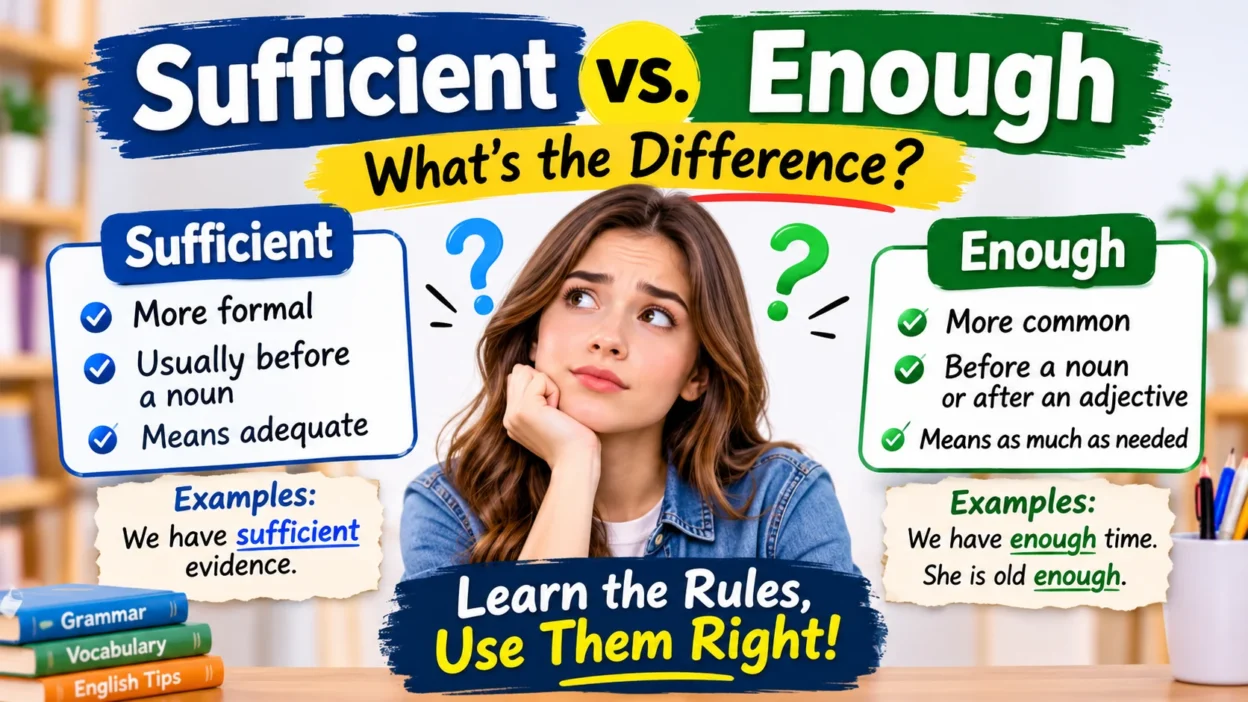
Sufficient and enough both mean having the required amount or degree of something. However, sufficient is generally more formal, while enough is more common in everyday conversation. Use sufficient before a noun or after a linking verb, and use enough before a noun or after an adjective or adverb.
Why Do People Confuse Sufficient and Enough?
People often confuse these words because they communicate almost the same basic idea. Both indicate that something meets a particular need, requirement, or standard.
For example:
- We have sufficient food for everyone.
- We have enough food for everyone.
Both sentences communicate that there is an adequate amount of food.
The confusion usually comes from their different grammatical patterns. While sufficient follows specific adjective structures, enough can function as a determiner, pronoun, or adverb.
Their tone also differs. Sufficient sounds more formal, whereas enough feels natural in everyday communication.
What Does Sufficient Mean?
Sufficient is an adjective meaning adequate, satisfactory, or enough to meet a particular need or requirement.
It describes something that meets a necessary standard without necessarily being extra or excessive.
For example:
- We have sufficient evidence to support the claim.
- The company has sufficient resources to complete the project.
- Her explanation was sufficient for the assignment.
In these examples, sufficient communicates that the available amount or quality meets the required standard.
When to Use Sufficient
Use sufficient when discussing requirements, resources, evidence, qualifications, or conditions, especially in formal situations.
Common expressions include:
- Sufficient evidence
- Sufficient information
- Sufficient time
- Sufficient resources
- Sufficient knowledge
- Sufficient experience
Examples of sufficient in sentences:
- The teacher provided sufficient information for the students.
- We have sufficient time to finish the presentation.
- The investigation found sufficient evidence to support the conclusion.
- His experience is sufficient for the position.
- The organization needs sufficient funding to continue its work.
What Does Enough Mean?
Enough means as much or as many as necessary, or to the required degree.
It can describe quantities, qualities, abilities, and conditions. Unlike sufficient, it is commonly used in casual conversations and everyday writing.
For example:
- We have enough food for dinner.
- She is old enough to drive.
- I have enough money to buy a new phone.
In each sentence, enough indicates that a particular requirement has been met.
When to Use Enough
Use enough when talking about everyday needs, quantities, abilities, and situations.
Common expressions include:
- Enough money
- Enough time
- Enough space
- Enough food
- Good enough
- Strong enough
- Fast enough
Examples of enough in sentences:
- I have enough money to pay the bills.
- There is enough space for everyone in the room.
- She is confident enough to speak in public.
- We don’t have enough time to visit the museum.
- The coffee is hot enough to drink.
Sufficient vs. Enough: Key Differences
Although both words express adequacy, their grammatical functions and levels of formality are different.
| Feature | Sufficient | Enough |
|---|---|---|
| Meaning | Adequate or satisfactory | As much or as many as needed |
| Part of speech | Adjective | Determiner, pronoun, adverb |
| Tone | More formal | Neutral and conversational |
| Before nouns | Sufficient food | Enough food |
| After adjectives | Sufficiently good | Good enough |
| After adverbs | Sufficiently quickly | Quickly enough |
| Everyday use | Less common | Very common |
| Formal writing | Frequently used | Also acceptable |
| Negative form | Insufficient | Not enough |
| Example | Sufficient evidence | Enough evidence |
The biggest difference is their sentence structure. Sufficient usually comes before a noun, while enough can appear in different positions depending on its grammatical function.
Parts of Speech: Sufficient vs. Enough
Understanding their parts of speech makes it easier to use these words correctly.
Sufficient as an Adjective
Sufficient functions as an adjective. It describes if something meets a particular requirement.
Examples:
- Sufficient food
- Sufficient preparation
- Sufficient evidence
- Sufficient knowledge
It can also appear after linking verbs such as is, are, was, and seems.
For example:
- The available information is sufficient.
- Her qualifications seem sufficient.
Enough as a Determiner
When enough comes before a noun, it indicates an adequate quantity.
Examples:
- We have enough chairs.
- She needs enough practice.
- There isn’t enough water.
Enough as an Adverb
When enough describes an adjective or another adverb, it usually comes after the word it modifies.
Examples:
- He is strong enough.
- The room is warm enough.
- She speaks clearly enough.
Enough as a Pronoun
Enough can also stand alone when the noun is understood from the context.
Examples:
- I have enough.
- We don’t need more; this is enough.
- Have you eaten enough?
Sufficient vs. Enough: Grammar Rules and Sentence Structure
Both words follow different grammatical patterns. Learning these structures will help you create correct sentences.
1. Sufficient + Noun
Place sufficient before a noun.
Correct examples:
- We need sufficient information.
- They have sufficient supplies.
- The school provides sufficient support.
2. Be + Sufficient
You can use sufficient after a linking verb.
Correct examples:
- The explanation is sufficient.
- The available evidence was sufficient.
- This amount should be sufficient.
3. Enough + Noun
Place enough before a noun.
Correct examples:
- We have enough chairs.
- She has enough experience.
- There is enough food.
4. Adjective + Enough
Place enough after an adjective.
Correct examples:
- The bag is large enough.
- He is mature enough.
- The instructions are clear enough.
5. Adverb + Enough
Place enough after an adverb.
Correct examples:
- She runs quickly enough.
- He explained the topic clearly enough.
- They arrived early enough.
6. Sufficiently + Adjective or Adverb
Use sufficiently, the adverb form of sufficient, before an adjective or adverb.
Correct examples:
- The room is sufficiently large.
- She prepared sufficiently well.
- The evidence was sufficiently strong.
Notice that sufficiently large and large enough have similar meanings but different word orders.
When Should You Use Sufficient Instead of Enough?
Choose sufficient when you want your writing to sound formal, precise, or professional.
It works particularly well in academic papers, workplace documents, official reports, and technical explanations.
Use sufficient in these situations:
- Academic writing: The research provides sufficient evidence.
- Business communication: We have sufficient resources for the project.
- Official documents: Applicants must provide sufficient identification.
- Professional discussions: The available budget is sufficient.
- Research reports: The study collected sufficient data.
In these situations, sufficient creates a formal and objective tone.
When Should You Use Enough Instead of Sufficient?
Choose enough when communicating naturally in everyday situations.
It is particularly useful when discussing personal needs, daily activities, quantities, and abilities.
Use enough in these situations:
- Daily conversations: Do we have enough milk?
- Shopping: I don’t have enough money.
- Education: Is this explanation clear enough?
- Travel: We have enough time to catch the bus.
- Personal decisions: Are you strong enough to handle this?
Although enough is common in conversation, it is also perfectly acceptable in professional and academic writing when it fits the sentence.
15 Practical Examples of Sufficient vs. Enough
Here are practical examples that demonstrate how both words work in different contexts.
- We have sufficient food for the guests.
- We have enough food for the guests.
- The report contains sufficient details.
- The report contains enough details.
- She has sufficient experience for the job.
- She has enough experience for the job.
- The room is large enough for ten people.
- The available space is sufficient for ten people.
- There isn’t enough water for everyone.
- The water supply is not sufficient for everyone.
- His explanation was sufficient to answer the question.
- His explanation was good enough to answer the question.
- The company needs sufficient funding.
- The company needs enough funding.
- Are you prepared enough for the examination?
These examples show that the words often communicate similar ideas, but their grammatical structures must remain correct.
Common Mistakes When Using Sufficient and Enough
English learners sometimes use these words incorrectly because they assume they can replace each other in every sentence.
Here are common mistakes and their corrections.
Mistake 1: Placing Enough Before an Adjective
Incorrect:
– She is enough intelligent to understand.
Correct:
– She is intelligent enough to understand.
Explanation: When enough modifies an adjective, it comes after the adjective.
Mistake 2: Using Sufficiently Before a Noun
Incorrect:
– We have sufficiently food.
Correct:
- We have sufficient food.
- We have enough food.
Explanation: Use sufficient or enough before a noun, not sufficiently.
Mistake 3: Saying Enough Sufficient
Incorrect:
– We have enough sufficient information.
Correct:
- We have sufficient information.
- We have enough information.
Explanation: Both words express adequacy, so combining them this way is unnecessary.
Mistake 4: Confusing Sufficient and Sufficiently
Incorrect:
– The explanation is sufficiently.
Correct:
– The explanation is sufficient.
Explanation: Sufficient is an adjective, while sufficiently is an adverb.
Mistake 5: Using Enough After a Noun
Incorrect:
– We have chairs enough for everyone.
Correct:
– We have enough chairs for everyone.
Explanation: In ordinary modern American English, enough generally comes before the noun it describes.
Easy Memory Trick: Sufficient vs. Enough
Remember this simple rule:
- Sufficient = Formal and professional.
- Enough = Everyday and flexible.
There is another useful grammar trick:
- Sufficient food.
- Enough food.
- Good enough.
- Large enough.
- Sufficiently good.
Remember that enough comes before nouns but after adjectives and adverbs. This simple pattern will help you avoid many common mistakes.
American vs. British English: Is There a Difference?
There is no significant difference between American and British English in the meaning or basic grammatical use of sufficient and enough.
Both varieties use these words in essentially the same way.
For example:
- American English: We have enough time.
- British English: We have enough time.
Similarly:
- American English: There is sufficient evidence.
- British English: There is sufficient evidence.
The main difference is not regional but stylistic. Enough is more conversational, while sufficient tends to sound more formal in both varieties.
Similar and Related Words
Several English words have meanings close to sufficient and enough. However, each has slightly different uses.
1. Adequate
Means acceptable or satisfactory for a particular purpose.
Example: The room has adequate lighting.
2. Ample
Means more than enough or plenty.
Example: We have ample time to complete the assignment.
3. Plenty
Means a large or generous amount.
Example: There is plenty of food for everyone.
4. Appropriate
Means suitable or correct for a particular situation.
Example: She wore appropriate clothing for the interview.
5. Adequately
An adverb meaning in a satisfactory or sufficient way.
Example: The students were adequately prepared.
6. Insufficient
The opposite of sufficient, meaning not enough.
Example: The available evidence was insufficient.
7. Inadequate
Means not good enough or not satisfactory.
Example: The explanation was inadequate.
Sufficient vs. Enough: Opposite Words
Understanding the opposites can help you expand your vocabulary.
| Word | Opposite or Negative Expression |
|---|---|
| Sufficient | Insufficient |
| Enough | Not enough |
| Adequate | Inadequate |
| Ample | Limited |
| Plenty | Scarcity |
For example:
- We have sufficient resources. / We have insufficient resources.
- We have enough money. / We don’t have enough money.
These expressions help you describe situations where requirements are either met or unmet.
Can Sufficient and Enough Be Used Interchangeably?
Yes, in many situations, sufficient and enough can be used interchangeably without changing the basic meaning.
For example:
- We have sufficient time.
- We have enough time.
Both sentences indicate that the available time meets the requirement.
However, they cannot replace each other in every grammatical structure.
For example:
- She is old enough to drive. (Correct)
- She is old sufficient to drive. (Incorrect)
You could instead say:
– She is sufficiently old to drive.
Therefore, always consider grammar and sentence structure before replacing one word with the other.
Sufficient vs. Enough in Academic and Professional Writing
Both words are useful in formal communication, but sufficient is often preferred when describing requirements, evidence, qualifications, and resources.
For example:
Academic writing:
- The study provides sufficient evidence to support the hypothesis.
- The research does not contain enough information to establish a conclusion.
Professional writing:
- The department has sufficient staff to manage the project.
- We have enough time to complete the scheduled tasks.
Neither word is automatically better. The best choice depends on the sentence, intended meaning, and level of formality.
FAQs:
1. Is sufficient the same as enough?
Yes. Both words mean having the required amount or degree of something. However, sufficient generally sounds more formal, while enough is more common in everyday English. Their grammatical structures are also different.
2. Is sufficient more formal than enough?
Yes. Sufficient is generally considered more formal and is frequently used in academic, professional, and official writing. Enough is more conversational and natural in daily communication, although it is also appropriate in formal writing.
3. Is enough an adjective or an adverb?
Enough can function as a determiner, pronoun, or adverb. It works as a determiner before nouns, as a pronoun when standing alone, and as an adverb after adjectives or other adverbs.
4. What is the difference between sufficient and sufficiently?
Sufficient is an adjective that describes if something is adequate. Sufficiently is an adverb that describes the degree or manner of an action or quality. For example, “sufficient information” and “sufficiently prepared.”
5. Can I use enough in formal writing?
Yes. Enough is grammatically correct in formal writing. You can use it in academic papers, business documents, and professional communication. However, sufficient may sound more appropriate when discussing requirements, evidence, or resources.
6. What is the opposite of sufficient?
The opposite of sufficient is insufficient. It describes something that does not meet the necessary amount, standard, or requirement. For example, “The available information is insufficient to support the conclusion.”
7. Is it correct to say sufficiently enough?
No. In ordinary English, sufficiently enough is redundant because both words communicate adequacy. Instead, say “sufficiently prepared” or “prepared enough,” depending on your intended sentence structure.
8. Which word should English beginners learn first?
Beginners should learn enough first because it is extremely common in everyday conversations and has several useful grammatical patterns. Learning sufficient afterward will help them understand formal writing and expand their vocabulary.
Remember This
Keep these five important points in mind:
- Sufficient means adequate or satisfactory.
- Enough means as much or as many as necessary.
- Sufficient generally sounds more formal.
- Enough is more common in everyday English.
- Use enough before nouns but after adjectives and adverbs.
Learning these simple rules will make it easier to choose the correct word in different situations.
Conclusion
Understanding sufficient vs. enough is an important step toward improving your English vocabulary and grammar. Both words express the idea of adequacy, but they differ in formality and sentence structure. Sufficient is generally preferred in formal and professional situations, while enough is more flexible and natural in everyday communication. Knowing their meanings and grammatical patterns will help you express yourself clearly.
The best way to remember their difference is to practice using them in real sentences. Try writing examples with sufficient food, enough time, good enough, and sufficiently prepared. With regular practice, you will become more confident about choosing the right word and avoiding common English grammar mistakes.