
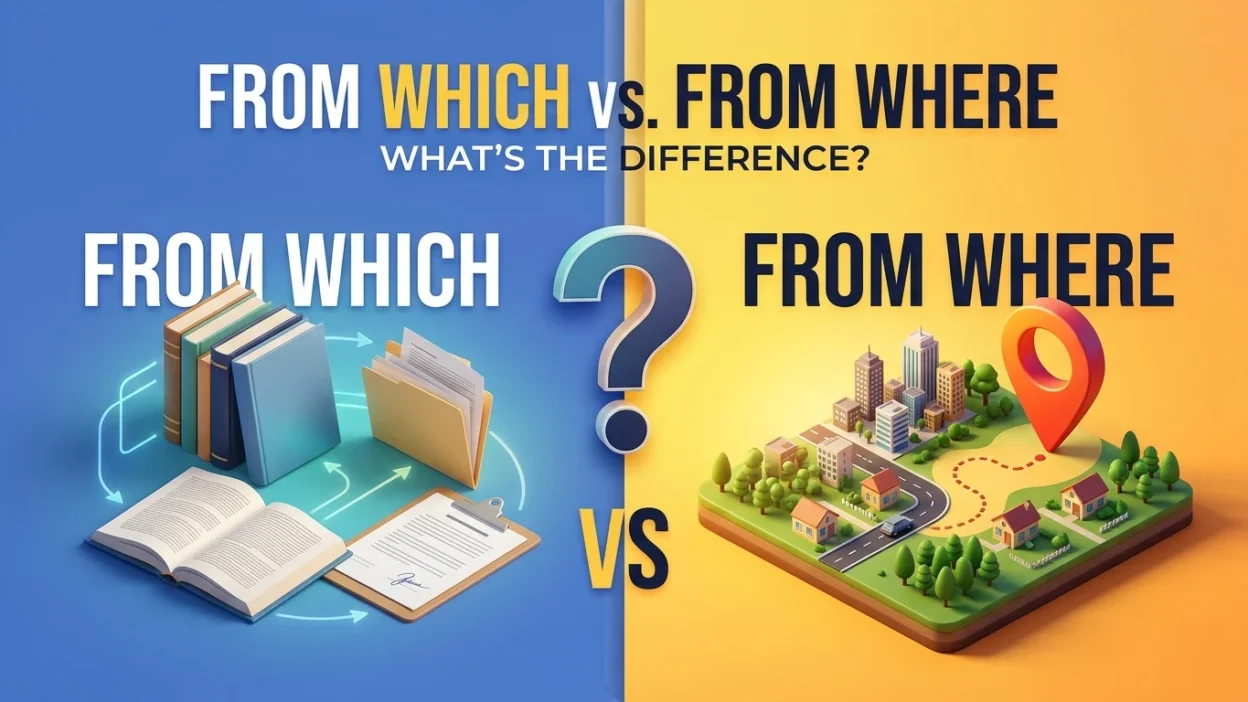
If you have ever wondered if to say “from which” or “from where,” you are not alone. Both expressions are grammatically correct, but they serve different purposes in English. The main difference is that “from which” usually refers to a specific noun, object, source, or situation, while “from where” refers to a place, location, or starting point. Choosing the right expression depends on what you are talking about and how your sentence is structured.
Understanding the difference between from which and from where can help you write clearer sentences, avoid grammatical mistakes, and communicate more naturally. If you are a student, an English learner, or a fluent speaker looking to improve your grammar, learning when to use each expression will make your English more accurate and confident.
Quick Answer: From Which vs. From Where
Use “from which” when referring to a specific noun, object, source, or previously mentioned thing. Use “from where” when referring to a physical location or starting point. For example, “The box from which I took the book” identifies an object, while “The city from where I came” identifies a place. In everyday American English, “where … from” is often more natural.
1. Why Do People Confuse From Which and From Where?
People often confuse these expressions because both contain the preposition “from” and introduce information about an origin or starting point.
The confusion becomes greater when someone describes a location, source, or object. In some sentences, both expressions may seem possible, but their grammatical structures and naturalness can differ.
Here are three common reasons for this confusion:
- Similar meanings: Both expressions can communicate where something originates.
- Different grammar: “Which” refers to a noun, while “where” refers to a place.
- Sentence structure: The position of the preposition can change how natural a sentence sounds.
Understanding the role of each word makes the difference much easier to recognize.
2. What Does From Which Mean?
“From which” is a prepositional expression used to refer to a particular thing, object, source, or previously mentioned noun.
It combines two words:
- From: A preposition that indicates origin, source, or starting point.
- Which: A pronoun or determiner used to identify something from a particular group or category.
Together, they help explain the origin or source of something.
For example:
“The drawer from which I took the keys was locked.”
In this sentence, “from which” refers to the drawer. It identifies the specific object where the keys were located.
Examples of From Which
- The document from which I copied the information was outdated.
- The company from which we purchased the equipment offers a warranty.
- The box from which she removed the toys was damaged.
- The book from which this quotation comes is very popular.
- The website from which I downloaded the file is trustworthy.
When Is From Which Appropriate?
Use “from which” when you are referring to:
- A particular object or item.
- A document, book, or written source.
- An organization or company.
- A specific material or substance.
- An idea, situation, or process.
Example: The report from which these statistics were taken contains useful information.
Here, “which” refers to the report rather than a physical location.
3. What Does From Where Mean?
“From where” is an expression used to ask about or describe the place, location, or starting point of something.
It combines:
- From: A preposition indicating origin or movement away from a point.
- Where: An adverb referring to a place or location.
The expression is particularly useful when the sentence focuses on geographical origin or the location where something began.
For example:
“Where did you come from?”
This question asks about someone’s place of origin or previous location.
Examples of From Where
- From where did you get this beautiful painting?
- The village from where my grandparents came is very peaceful.
- I cannot remember from where I received that email.
- From where does this river begin?
- The town from where she started her journey is quite small.
When Is From Where Appropriate?
Use “from where” when discussing:
- A geographical location.
- A city, town, or village.
- A starting point of a journey.
- The origin of a person or object in a place-based context.
- A location from which something moves or begins.
Example: The airport from where our flight departed was extremely busy.
Here, “where” refers to the airport as a location.
4. From Which vs. From Where: Main Differences
Although these expressions can sometimes communicate similar information, their grammatical functions are different.
| Feature | From Which | From Where |
|---|---|---|
| Main function | Refers to a noun | Refers to a place |
| Word type | Preposition + pronoun/determiner | Preposition + adverb |
| Main focus | Object, source, or thing | Location or starting point |
| Common use | Formal writing | Location-based descriptions |
| Example | The book from which I learned | The city from where I came |
| Main question | From which thing? | From what place? |
The easiest way to understand the difference is to identify what the expression refers to. If it refers to a particular thing, “from which” is generally appropriate. If it refers to a location, “from where” may be appropriate.
5. Understanding the Parts of Speech
Understanding the grammatical roles of “which” and “where” makes choosing between them easier.
Which as a Pronoun or Determiner
“Which” is used to identify a particular person or thing from a group or to introduce a relative clause.
Examples:
- Which book do you prefer?
- The house in which they live is beautiful.
- The source from which the information came is reliable.
In the last example, “which” refers to the noun “source.”
Where as an Adverb
“Where” is generally an adverb of place. It identifies the location in which something happens or from which something originates.
Examples:
- Where do you live?
- This is the place where we first met.
- I know where the package came from.
The word “where” provides information about location rather than identifying an object.
6. Grammatical Structure of From Which
“From which” commonly appears in formal sentences, especially when the preposition comes before a relative pronoun.
Basic structure:
Noun + from which + subject + verb
Examples:
- The building from which the smoke emerged was abandoned.
- The source from which the water flows is natural.
- The material from which the chair was made is expensive.
It can also appear in questions:
- From which department did you receive the message?
- From which book did you learn this information?
This structure is grammatically correct, although everyday American English often places the preposition at the end of the sentence.
7. Grammatical Structure of From Where
“From where” is used in questions and statements involving a place or geographical origin.
Basic structure:
From where + auxiliary verb + subject + main verb?
Examples:
- From where did the train depart?
- From where does this road begin?
- From where did you purchase these flowers?
It can also appear within a statement:
- I know from where the problem started.
- She explained from where the guests would arrive.
- We discovered from where the sound was coming.
In everyday conversation, many speakers prefer simpler alternatives such as “Where did the train depart from?”
8. When Should You Use From Which?
Choose “from which” when the sentence refers to a specific thing rather than simply identifying a geographical location.
Common situations include:
1. Referring to documents
The article from which I collected these facts is informative.
2. Referring to objects
The container from which she poured the juice was clean.
3. Referring to sources
The website from which the image originated is well-known.
4. Referring to materials
The fabric from which this dress was made is soft.
5. Referring to organizations
The institution from which he graduated has an excellent reputation.
9. When Should You Use From Where?
Choose “from where” when the main idea concerns a place, location, or geographical starting point.
Common situations include:
1. Asking about someone’s origin
From where did your family originally come?
2. Describing a journey
The station from where we departed was crowded.
3. Identifying geographical locations
The region from where these flowers grow has a mild climate.
4. Discussing movement
From where did the visitors enter the building?
5. Explaining a starting point
The road from where the race begins is closed.
10. From Which vs. From Where in Everyday American English
Both expressions are understandable in American English, but they do not always sound equally natural.
Americans frequently use prepositions at the end of questions and relative clauses.
For example:
- Formal: From which city are you traveling?
- Natural conversation: Which city are you traveling from?
Similarly:
- Formal: The town from where she came was small.
- Natural alternative: The town where she came from was small.
The second version is common in conversation, although some writers prefer to restructure the sentence for smoother formal writing.
11. Common Mistakes With From Which and From Where
English learners sometimes use these expressions interchangeably without considering their grammatical functions.
Here are common mistakes and their corrections.
| Incorrect or Awkward | Better Version | Explanation |
|---|---|---|
| The book from where I learned this. | The book from which I learned this. | Refers to a book. |
| The city from which I was born. | The city where I was born. | Refers to a location. |
| From which are you coming? | Where are you coming from? | More natural question structure. |
| The place from which I live. | The place where I live. | Living occurs at a location. |
| The source from where the data came. | The source from which the data came. | Refers to a source. |
Remember that grammar and natural expression both matter. A sentence can sometimes be understandable but still sound awkward to native speakers.
12. Is From Which More Formal Than From Where?
“From which” often sounds more formal because it is commonly used in carefully structured relative clauses and academic writing.
For example:
“The laboratory from which the samples were collected follows strict safety procedures.”
“From where” can also appear in formal writing, particularly when discussing geographical locations.
For example:
“The region from where the river originates receives heavy rainfall.”
Neither expression is automatically formal or informal in every context. The subject and sentence construction influence the tone.
13. Is From Where Grammatically Correct?
Yes, “from where” is grammatically correct when it refers to a location or starting point.
For example:
“From where did you purchase this furniture?”
This is a correct question, although many Americans would more naturally say:
“Where did you purchase this furniture from?”
Another example:
“The village from where the family moved is surrounded by mountains.”
This construction is also acceptable. However, “the village where the family moved from” is often more conversational.
14. Can You Use From Which for Places?
Yes. “Which” can refer to a place when the place is treated as a specific noun.
For example:
“The town from which he traveled is famous for its historical buildings.”
Here, “which” refers to the noun “town.”
This is an important distinction: “which” is not limited to objects. It can refer to places, organizations, sources, and other nouns.
Therefore, the choice is not simply about if something is a physical object or a place. It also depends on grammatical structure and intended meaning.
15. Can You Use From Where for Things?
Sometimes, yes, when the thing is being understood as a location or source point.
For example:
“The website from where I downloaded the software has changed its design.”
This is understandable because the website is treated as the source location.
However, in polished writing, “the website from which I downloaded the software” is generally a better choice.
The key is to consider if you are emphasizing a location or a specific noun as the source.
16. From Which vs. Where From
These expressions are closely related, but their sentence structures differ.
“From which” usually appears in formal questions or relative clauses.
Example:
“From which country does this product originate?”
“Where from” is more common in conversational questions.
Example:
“Where are you from?”
Both can ask about origin, but “where from” is generally more natural in everyday conversation.
17. From Which vs. Which From
“From which” is a standard grammatical construction. “Which from” is not normally used as a replacement.
Compare:
- Correct: From which store did you buy this jacket?
- Incorrect: Which from store did you buy this jacket?
However, “which” can come before a noun in a different construction:
“Which store did you buy this jacket from?”
This is natural American English because the preposition appears at the end.
18. From Where vs. Where From
Both expressions can communicate origin, but they appear in different sentence patterns.
From where:
“From where did the package arrive?”
Where from:
“Where did the package come from?”
The first construction places the preposition before “where.” The second places it at the end.
Both are grammatically understandable, but the second is more common in everyday American conversation.
19. From Which vs. Where: Are They Interchangeable?
No, they are not always interchangeable.
“From which” identifies a noun, while “where” identifies a place or location.
Compare:
- The website from which I downloaded the file is reliable.
- The location where I downloaded the file was crowded.
The first sentence identifies the source of the file. The second identifies the physical location where the downloading happened.
Changing one expression for another can change the meaning or make the sentence grammatically awkward.
20. Formal and Informal Sentence Examples
The following examples show how the same general idea can be expressed in different styles.
| Formal English | Everyday American English |
|---|---|
| From which city are you traveling? | Which city are you traveling from? |
| The book from which I learned was useful. | The book I learned from was useful. |
| From where did the sound originate? | Where did the sound come from? |
| The company from which I purchased it was helpful. | The company I bought it from was helpful. |
| From which country does she come? | What country is she from? |
The informal versions are often shorter and more natural in everyday conversations.
21. From Which vs. From Where in Academic Writing
Academic writing often uses “from which” because it creates clear relationships between nouns and their sources.
For example:
“The dataset from which the researchers collected their results contained 5,000 observations.”
This construction identifies the dataset precisely.
“From where” can also be used in academic writing when discussing geographical origins or locations.
For example:
“The coastal region from where the samples were collected experiences seasonal flooding.”
Choose the expression that accurately describes the relationship rather than automatically selecting the more formal-sounding option.
22. From Which vs. From Where in Questions
Both expressions can introduce questions, but the information being requested is different.
Questions with from which:
- From which university did you graduate?
- From which department did the request originate?
- From which book did you get this quotation?
- From which company did you purchase the equipment?
- From which source did the information come?
Questions with from where:
- From where did you travel?
- From where did the visitors arrive?
- From where does this river flow?
- From where did the noise originate?
- From where did you get this idea?
Notice that “from which” often asks someone to identify a particular noun, while “from where” emphasizes the location.
23. How to Avoid Repeating From Which and From Where
Repeating the same expressions can make writing sound unnatural. Fortunately, English offers several alternatives.
Consider these options:
- Where did it come from?
- What is its origin?
- Which source provided this information?
- Where did the journey begin?
- What location did they depart from?
- Which organization supplied the product?
These alternatives can make your writing more direct and conversational.
24. Similar and Related Words
Learning related expressions can help you understand the difference between origin, location, and source.
| Expression | Meaning | Example |
|---|---|---|
| Where | Refers to a place | Where do you live? |
| Which | Identifies a particular thing | Which book is yours? |
| Whence | From what place or source | Whence came this tradition? |
| Wherever | At or to any place | Go wherever you want. |
| Somewhere | An unspecified place | I left it somewhere. |
| Origin | The starting point or source | What is the origin of this word? |
| Source | Where something comes from | Identify the source of the information. |
| Location | A particular place | What is the location of the office? |
“Whence” is a more literary or old-fashioned word and is uncommon in everyday American English.
25. American vs. British English Differences
There is no major grammatical difference between American and British English regarding “from which” and “from where.” Both expressions are understood and used in both varieties.
However, everyday sentence preferences can vary between individual speakers and writing styles.
For example:
- More formal: From which country are you traveling?
- Conversational: Which country are you traveling from?
Both American and British speakers commonly use prepositions at the end of questions and relative clauses.
The important distinction is grammatical meaning, not nationality.
26. Easy Memory Trick: How to Remember the Difference
Here is a simple way to remember when to use each expression.
Think of WHICH as a THING and WHERE as a PLACE.
- From which = From a particular thing or identified noun.
- From where = From a particular location or starting point.
For example:
“The website from which I downloaded the file.”
Think about the website as the identified source.
“The city from where I traveled.”
Think about the city as the geographical location.
If you remember this simple distinction, you will find it easier to choose the correct expression.
27. Ten Additional Practical Examples
Here are additional sentences showing how these expressions work in real-life situations.
- The university from which she graduated is highly respected.
- From where did the tourists begin their journey?
- The folder from which I deleted the files was important.
- The country from where these products are shipped has strict regulations.
- From which department should I request permission?
- The restaurant from which we ordered dinner has excellent reviews.
- Do you know from where this information originated?
- The laboratory from which the samples came follows strict procedures.
- The neighborhood from where he moved has changed significantly.
- From which website did you download the application?
These examples demonstrate that the choice depends on the noun or location being discussed.
28. Practice Exercise: Test Your Understanding
Choose the correct expression to complete each sentence.
- The book _____ I borrowed this information was interesting.
- _____ did your parents originally come?
- The company _____ we purchased the computer offers technical support.
- _____ did the airplane depart?
- The document _____ the figures were taken is available online.
Answers:
- From which
- From where
- From which
- From where
- From which
These answers follow the distinction between referring to a specific noun and referring to a location.
29. Final Verdict: From Which or From Where?
Both expressions are grammatically correct, but they are not perfect substitutes for each other.
Use “from which” when you want to identify a specific noun, such as a book, document, company, source, or object. Use “from where” when you want to emphasize a geographical location, place, or starting point.
In everyday American English, you can often make your sentences sound more natural by placing “from” at the end.
For example:
- Formal: From which city are you coming?
- Natural: Which city are you coming from?
The best choice depends on your intended meaning, grammatical structure, and writing style.
FAQs:
1. Is it from which or from where?
Both are correct, but they have different uses. “From which” generally refers to a specific noun or source, while “from where” refers to a location or starting point. Always consider what the expression describes before choosing one.
2. Is from where grammatically correct?
Yes, “from where” is grammatically correct when referring to a location or geographical starting point. For example, “From where did the train depart?” is correct. However, “Where did the train depart from?” sounds more natural in everyday American English.
3. Can I use from which when talking about a city?
Yes. “Which” can refer to a city because a city is a noun. For example, “The city from which she came is beautiful” is grammatically correct. You can also say, “The city she came from is beautiful.”
4. Is from which more formal than from where?
“From which” often sounds more formal because it frequently appears in academic writing and carefully structured relative clauses. However, “from where” can also be appropriate in formal writing, especially when discussing geographical locations.
5. Can I end a sentence with from?
Yes. Ending a sentence with a preposition is grammatically acceptable in modern English. For example, “Which country are you from?” is completely correct and sounds natural in everyday American conversation.
6. What is the difference between where and which?
“Where” generally refers to a location, while “which” identifies a particular person or thing from a group or introduces a relative clause. For example, “Where do you live?” asks about a place, while “Which house is yours?” identifies a particular house.
7. Which is better: the place from where I came or the place from which I came?
Both can be understood, but “the place from which I came” is a well-established formal construction. In everyday American English, “the place I came from” is usually more natural and straightforward.
Remember This
- From which: Use it to refer to a specific noun, object, document, or source.
- From where: Use it to refer to a location or starting point.
- Where … from: Often the most natural conversational construction.
- Which … from: A natural alternative when identifying a particular noun.
- Both expressions are grammatically correct when used in the right context.
Conclusion
Understanding the difference between “from which” and “from where” is easier when you focus on what each expression describes. “From which” generally connects a preposition to a specific noun, while “from where” emphasizes a location or geographical starting point. Although both expressions can be used to discuss origins, their grammatical functions and sentence structures are different.
For everyday American English, remember that expressions such as “Where did it come from?” and “Which book did you learn from?” often sound more natural than their formal alternatives. Practice using both expressions in different sentences, and you will gradually become more confident in choosing the right one.